Once all Tolkien's pseudo-scholarship is gone, all you are left with is a chase movie. There's this hobbit, he's got a ring, the baddies want to get it and he has to keep running from them.

26 March 2006
KILL ALL HOBBITS
Nick Cohen today is mainly making pertinent points about cash-for-peerages -- but he also expresses succinctly just why JRR Tolkien sucks:

22 March 2006
GOOD BUDGET
Gordon Brown has done what he had to do. The spending splurge on education is a serious challenge to the Tories — and it puts the sterile education bill arguments about the structure of the school system into perspective. Who really cares about the precise role of local education authorities if we're chucking cash at schools? The environmentalist stuff is also promising — though of course I could have done without the increases on beer and fags.
After a week of angst, I'm back on board with Labour again and will deliver those leaflets after all. And I'm not half as glum as I was about Broon becoming leader, though I'd still prefer Charles Clarke...
After a week of angst, I'm back on board with Labour again and will deliver those leaflets after all. And I'm not half as glum as I was about Broon becoming leader, though I'd still prefer Charles Clarke...
19 March 2006
LABOUR'S LOANS PROBLEM
There has been lots of sensible stuff written about Labour's secret pre-election loans, and it's clear that the story creates a massive problem for Tony Blair, who appears to have been the only person who knew anything about it apart from Matt Carter, the party's general secretary in the run-up to the last general election. Dave Osler has made Labour's funding a speciality, and I recommend his take on it: start here and move with the groove.
One point that no one has aired but is nevertheless relevant: the reason Labour needed to raise cash by borrowing before the 2005 election was that its traditional fundraising was getting nowhere. Membership revenues were disastrously down; the telephone fundraising that had worked wonders in 1992 and 1997 (lots of individual members and supporters volunteering £50 or £100) stopped working in 2001; the unions were prepared to cough up so much but no more; and the party's campaign for donations from rich individuals was on the rocks because by 2005 most rich individuals didn't want to make a big thing of being on Labour's donors' list. Loans were a desperate measure to keep the party in business.
This is a story of a political party that looks to be on its last legs (which is not to say that the Tories, who borrowed a lot more, are in better shape). And it's utterly demoralising for everyone who has attempted to keep the Labour Party going as an organisation that mobilises ordinary people's — rather than millionaires' — interests.
I'm shocked, and disinclined to get my finger out for the local elections. I can't see any alternative to Labour, as long as it is cleaned up ... but it needs to be cleaned up fast for me and everyone else I know who works for the party.
This looks like a Lloyd George-style loans-for-peerages scam that stinks of old-fashioned corruption, a betrayal of all we hold dear — even though we've given up the rheoric of betrayal. Blair has some work to do to regain any kind of credibility. And I think it's beyond him.
One point that no one has aired but is nevertheless relevant: the reason Labour needed to raise cash by borrowing before the 2005 election was that its traditional fundraising was getting nowhere. Membership revenues were disastrously down; the telephone fundraising that had worked wonders in 1992 and 1997 (lots of individual members and supporters volunteering £50 or £100) stopped working in 2001; the unions were prepared to cough up so much but no more; and the party's campaign for donations from rich individuals was on the rocks because by 2005 most rich individuals didn't want to make a big thing of being on Labour's donors' list. Loans were a desperate measure to keep the party in business.
This is a story of a political party that looks to be on its last legs (which is not to say that the Tories, who borrowed a lot more, are in better shape). And it's utterly demoralising for everyone who has attempted to keep the Labour Party going as an organisation that mobilises ordinary people's — rather than millionaires' — interests.
I'm shocked, and disinclined to get my finger out for the local elections. I can't see any alternative to Labour, as long as it is cleaned up ... but it needs to be cleaned up fast for me and everyone else I know who works for the party.
This looks like a Lloyd George-style loans-for-peerages scam that stinks of old-fashioned corruption, a betrayal of all we hold dear — even though we've given up the rheoric of betrayal. Blair has some work to do to regain any kind of credibility. And I think it's beyond him.
15 March 2006
QUITE RIGHT
Norm lays into Madeleine Bunting on Iraq — with some panache — here. (Bunting's piece is a boiler-plate leftist appeal to continue to ask who was guilty for the Iraq debacle etc.)
Bunting: 'This callow arrogance about the political cultures of other countries, more than any other issue, prompted my opposition to both wars.' That's an indirect way of saying (since it's a tough number to actually say it) that, in relation to Afghanistan and Iraq, projects of regime change and democratization were inevitably doomed because the indigenous cultures aren't receptive to them. No word about the millions in both countries who have come out to vote, under threat of violence against them if they did, showing every sign of a hunger for democracy. No word about the forces in those countries, trade unionists, women's groups, civic organizations, battling as best they can in desperate circumstances. No word.Stunning.
12 March 2006
MILOSEVIC DEAD
I'm not shedding any tears for Slobodan Milosevic, a vile monster whose megalomania and cynical manipulation of Serb nationalism turned the disintegration of Yugoslavia into bloody carnage. But it is a pity his death has cheated the process of justice. There are good pieces by Brendan Simms in the Sunday Times (here), Nerma Jelacic in the Observer (here) and Mark Thompson in the Sunday Telegraph (here). Thompson, who reported brilliantly on the end of Yugoslavia for Tribune and the New Statesman, reminds readers of the part played by British, French and American appeasement in sustaining Milosevic in power in the early 1990s, when limited military intervention could have stopped him in his tracks:
John Major was at a loss over the Balkans, while Douglas Hurd was firmly pro-Serb, as were the French president François Mitterrand and his foreign minister Roland Dumas. This trio probably saved Milosevic's bacon in the crucial first year of war. They couldn't save his public reputation, which vied with those of Hitler and Pol Pot.
Then David Owen decided, as senior European negotiator, that he had no alternative but to engage with Milosevic - and so promoted him as the key to peace. After Owen stepped down, the baton passed to Bill Clinton's envoy, Richard Holbrooke. Like other sophisticated diplomats, these men thought they had a special bond with the butcher of Belgrade (an entirely apt tabloid tag).
10 March 2006
IT PAINS ME BUT...
Despite my enthusiasm for Alan Brazil (known as Pele in his Ipswich Town days less for his skill than for his surname, unfortunately, though I still rate him), the commercial sports station's latest signing deserves only one response (feel free to reproduce graphic):


7 March 2006
PROLETARIAN GREETINGS TO THE PEOPLE'S REPORTER
Dave Osler, who was news editor on Tribune when I edited it many moons ago and who was nicknamed "the People's Reporter" by the subs on Lloyd's List, has started a blog here. Welcome to the blogosphere, comrade, though I'm not sure that getting into bed with the Militant Tendency, aka SPEW, the Socialist Party of England and Wales — as he suggests here — is really such a bright idea.
5 March 2006
THIS MACHINE KILLS FASCISTS
It's the 70th birthday of the Spitfire — and they've been flying some surviving planes around Southampton (click here and look for the video feed).


JOWELL ON THE ROPES
Tessa Jowell is one of the few Labour politicians about whom I have no strong opinion — but I've known for ages that her husband, the solicitor David Mills, was potentially a massive liability. I can't remember when his links with Silvio Berlusconi first surfaced, but it must have been at least five years ago. And before that, there was the little matter of his involvement with Bernie Ecclestone, the motor-racing entrepreneur who gave a massive donation to the Labour Party just when Labour was planning to ban sponsorship of sporting events by tobacco companies.
Now, I've no idea whether Mills took a bribe from Berlusconi or what Jowell knew about her husband's activities, but I can't help but agree with Peter Cole in the Independent on Sunday today (click here) when he says that the current hoo-hah about Mills's business dealings is anything but a vindication of the British press's fearless investigative journalism.
There has certainly been a prima facie case for investigating Mills's money for a long time — for the simple reasons (a) that he has been working for years for Berlusconi, a very rich and powerful man, to help him avoid tax; and (b) that Berlusconi has, to say the least, an extraordinarily murky past, some extremely dubious associates and a political-media power base that is a scandal in itself (on which see Paul Ginsborg's piece in the Observer here).
But the truth is that none of the British papers took very much interest in Mills until the story required the minimum of effort — because various Italian investigating magistrates turned up a large number of documents that suggest he might have done something very dodgy indeed. Fearless? Tell me another.
Now, I've no idea whether Mills took a bribe from Berlusconi or what Jowell knew about her husband's activities, but I can't help but agree with Peter Cole in the Independent on Sunday today (click here) when he says that the current hoo-hah about Mills's business dealings is anything but a vindication of the British press's fearless investigative journalism.
There has certainly been a prima facie case for investigating Mills's money for a long time — for the simple reasons (a) that he has been working for years for Berlusconi, a very rich and powerful man, to help him avoid tax; and (b) that Berlusconi has, to say the least, an extraordinarily murky past, some extremely dubious associates and a political-media power base that is a scandal in itself (on which see Paul Ginsborg's piece in the Observer here).
But the truth is that none of the British papers took very much interest in Mills until the story required the minimum of effort — because various Italian investigating magistrates turned up a large number of documents that suggest he might have done something very dodgy indeed. Fearless? Tell me another.
1 March 2006
BUY DANISH — 5
Unless I've missed something, not one paper in the UK ran this very coherent and reasonable piece by the culture editor of Jyllands Posten on why he published those cartoons or this interview with the cartoonist who drew the Prophet with a bomb in his turban. Have I lost the plot or have they in fact appeared somewhere?


22 February 2006
BUY DANISH — 4
I've been overwhelmed by recipes, most of them from people telling me I need to get into what's online. OK, OK. But this is very nice: tried it this evening and seriously tasty:
All I'd add next time is a bayleaf, but not sure when: maybe to the spuds?

Potato and Danish bacon soup
Eight thick slices Danish bacon, chopped
One large onion, chopped
Four large-ish red potatoes, peeled and cubed
One can cream of chicken soup
One small carton sour cream
One pint milk
Salt (to taste)
Pepper (to taste)
Fry bacon in frying pan until crisp. Add onion and saute 2 to 3 minutes. Drain. Boil potatoes in another pan for 10 to 15 minutes in not much water (couple of cups). Stir in soup, sour cream, bacon and onions. Add milk gradually, stirring constantly. Don't go mad and make it runny. Add salt and pepper. Heat to serving temperature. Do not boil.
All I'd add next time is a bayleaf, but not sure when: maybe to the spuds?

WHAT SHOULD GO ON RADIO 4 - 3
Very bad news. The brave Mark Damazer (Radio 4 controller), in the wake of his heroic resistance to protests against his getting rid of that silly theme tune that goes on for ages when no one is listening, is interviewed by the Evening Standard about the other rubbish his station puts out that ought to be chopped:
What of You and Yours, often maligned by critics as unfocused? "I told them after the latest burst of minor publicity [about the programme's future] that they were perfectly safe in my hands. For good reason: the audience has grown." Midweek? "You can't expect any massive upheaval there." Woman's Hour? "Discarding programmes which have big histories, brand names, is quite a tricky thing to do, especially if a programme is able to evolve."Aaaargh!
21 February 2006
19 February 2006
HOW TO LOSE THE NEXT ELECTION - 2
Here's the FT on the smoking ban:
Burning resentment at smoking ban in Labour's heartlands
Lighting up might not be the only habit broken in working men's clubs, where feelings are running high, writes Chris Tighe
If Labour wished to alienate supporters in its traditional heartlands, it is difficult to imagine a more effective way than presiding over a ban on smoking in working men's clubs.
Tony Blair might be well advised to stay away from Trimdon Labour Club. The one-time bedrock of grassroots support in his Sedgefield constituency, its members were outraged by Tuesday night's vote to ban smoking. They had hoped that membership clubs would be excluded from the ban.
"Disgraceful"; "nanny state"; an "encroachment of civil liberties"; "Margaret Thatcher in trousers" are some of the printable responses from north-east clubmen to the decision to ban smoking in their premises.
Tom Satterthwaitfe, secretary of the Northumberland Club and Institute Union, says: "Labour's not the working man's party now; it's not what it was when Wilson and them were in charge." His Newcastle office has been inundated with calls from angry clubmen. Labour, he says, might get a shock at the next election. "They've lost the plot."
It is not only the prospect that some clubs, if deserted by smokers, might close that has irritated him. Recent licensing and regulatory changes, all adding enormously to club overheads, have left him smarting about Labour's priorities.
Breaking a lifetime's habit, Mr Satterthwaite will not vote Labour at the next general election. He says he might switch to the Conservatives, depending on how David Cameron, the leader, shapes up. For a former miner, the son of a miner, this is a huge shift.
Down at Lemington Labour Club, on Newcastle's western edge, many share his disillusion. Traditional allegiances were already wobbling. Of a group of four one-time Labour men, one voted National Front at the last general election and one Conservative.
The two who stayed loyal are perturbed now. "Margaret Thatcher was replaced by a rightwing Labour government which has been trying to tell the working man what to do ever since," says ex-smoker Michael Lyon.
Some north-east clubs have contacted the CIU nationally suggesting that MPs be barred from clubs in protest.
David Clelland, MP for Tyne Bridge and Labour chairman of the all-party parliamentary group for non-profit making private members' clubs, accepts there will be a backlash against the total ban, which he did not support, but does not expect a disproportionate effect".
However Paul Trippett, manager of Trimdon Labour Club and one of the men who helped the young Blair secure nomination as Labour's Sedgefield candidate, is among those worried by the ban. He feels it illustrates Labour's "middle clas-sism". As a general election edges nearer, it will be a "running sore".
Banning fox hunting; promoting ID cards; outlawing public smoking; all trouble Mr Trippett, a Labour Durham county councillor. People worry "what next?", he says. The Conservatives can gain advantage here, he warns, by talking about freedom of the individual.
Mr Trippett fears the nanny state is taking hold. "I think people should be helped to stand on their own - and then left."
He suspects some middle-class Labour MPs do not understand the working class - especially those not motivated by health issues.
"Those who don't want to get into shape very much don't want to," he says. "I drive everywhere, I drink too much, I eat too much. That's what I want to do."
15 February 2006
HOW TO LOSE THE NEXT ELECTION - 1
The decision to ban smoking in pubs and clubs is wrong. If I want to have a cigarette with my beer, it's nobody's business but my own — and I really resent being told I can't by a bunch of non-smokers who visit the pub at most once a month for a nice meal.
But the ban is also, from the point of view of the Labour Party, stupid. Most of the people who are going to be angry about the ban are people who smoke in pubs and clubs. And a very large number of them are working-class and hitherto Labour voters. Even though opposition MPs also voted for the ban, it will inevitably be associated with the insufferable Patricia Hewitt and the government. It might not be Labour's poll tax, but I think it will cost the party dozens of seats.
But the ban is also, from the point of view of the Labour Party, stupid. Most of the people who are going to be angry about the ban are people who smoke in pubs and clubs. And a very large number of them are working-class and hitherto Labour voters. Even though opposition MPs also voted for the ban, it will inevitably be associated with the insufferable Patricia Hewitt and the government. It might not be Labour's poll tax, but I think it will cost the party dozens of seats.
12 February 2006
RESPECT BELIEVERS, NOT THEIR BELIEFS
Paul Anderson, Tribune column, 10 January 2006*
The hoo-hah over the publication of cartoon images of Muhammad has been so disproportionate that I’m almost apologetic about bringing it up in this column. Almost, but not quite — because someone has to make the point that the real story is the disproportionality of the hoo-hah.
The most remarkable thing about the cartoons published months ago in the Danish newspaper Jyllands-Posten is that only one of them is funny — the one of the Prophet greeting the suicide bombers in Paradise with the words “Stop, stop, we ran out of virgins”. (If you haven’t seen them, they’re on the internet here among other places.) The rest of them are at best dull and at worst asinine — the one of Muhammad with a bomb in his turban. But that might be because the origin of the cartoons was a complaint by a children’s author that illustrators would only work anonymously on a book explaining Islam to Danish kids for fear of violence from Islamist extremists. Maybe the cartoons weren’t supposed to be side-splittingly hilarious.
OK, the cartoons broke a Muslim prohibition on depicting the Prophet in illustrations. But so what? That prohibition has been broken inumerable times before without anyone making any fuss, not least by Muslims who don’t think it matters very much. More important, to state the obvious, it is not a prohibition most of the Jyllands-Posten cartoonists or the editors of Jyllands-Posten accept. And why should they, any more than they accept Muslim bans on eating pork or drinking alcohol or engaging in extra-marital sex?
All right, I admit that there is a difference, in that a devout Muslim in Copenhagen would not find it hard to avoid inadvertently munching bacon sandwiches, swigging beer or having sex but might easily inadvertently see the cartoons in Jyllands-Posten. Publishing, by definition, is not a simply matter of private behaviour.
It’s clear too, that Jyllands-Posten was deliberately attempting to provoke a reaction when it decided to publish, and by some accounts it seems to have been motivated by a rather crude antipathy to Islam.
I also accept that the cartoons might offend Muslims either because they include images of the Prophet or because a few of them (though by no means all) ridicule aspects of their faith — the ban on depicting the Prophet, the vision of Paradise, the doctrine of jihad (holy war).
But again, in the end, so what? Even if Jyllands-Posten’s provocation was gratuitous and unsophisticated — and I’m not convinced it was — it is entirely legitimate to ridicule religious belief. And much of Islam richly deserves ridicule. The same goes for Christianity, Judaism and every other religion. There is a long and distinguished tradition of ridiculing religion that goes back to the Enlightenment. And no one has the right not to be offended.
Which is not to say that Jyllands-Posten was right to publish the cartoons — just that it had a right to do so, and that that right is worth defending against the far-from-spontaneous expressions of Muslim outrage that swept the world last week. I would have expected Labour politicians in Britain to make this point emphatically and unambiguosly. Instead, we’ve had the grim spectacle of Jack Straw mumbling platitudes about how evil it is to give offence to believers and how important it is for editors to be “responsible”.
The British press has also played a far from glorious role in the affair. No newspaper has republished the cartoons — which is probably sensible given the hysteria whipped up against them by radical Islamists. Publication would place foreign correspondents and other Brits in severe danger in large swathes of the world.
But where were the clear expressions of the inalienable right to publish material offensive to religious believers? OK, there were a few in columns by the usual secularist suspects. The overwhelming majority of pundits and leader-writers opted for rambling on evasively about not pouring petrol on raging fires and the need to understand the depth of religious faith in the Islamic world. Only the Sun admitted — and then obliquely — that a major reason the papers didn’t publish is that they were scared that a Muslim boycott could harm sales.
This is not to suggest that secular democrats should abandon religious tolerance. Respect for the believer’s freedom to choose what he or she believes is another of the great legacies of the Enlightenment that deserves unconditional defence (against, among others, the most radical Islamists). But respect for the believer is not the same thing as respect for the believer’s belief. And if we can’t make it clear that this is a fundamental principle of our society, we’ve got a big problem.
* Copy not used as a result of a cock-up on the right date but run a week later. No hard feelings.

The hoo-hah over the publication of cartoon images of Muhammad has been so disproportionate that I’m almost apologetic about bringing it up in this column. Almost, but not quite — because someone has to make the point that the real story is the disproportionality of the hoo-hah.
The most remarkable thing about the cartoons published months ago in the Danish newspaper Jyllands-Posten is that only one of them is funny — the one of the Prophet greeting the suicide bombers in Paradise with the words “Stop, stop, we ran out of virgins”. (If you haven’t seen them, they’re on the internet here among other places.) The rest of them are at best dull and at worst asinine — the one of Muhammad with a bomb in his turban. But that might be because the origin of the cartoons was a complaint by a children’s author that illustrators would only work anonymously on a book explaining Islam to Danish kids for fear of violence from Islamist extremists. Maybe the cartoons weren’t supposed to be side-splittingly hilarious.
OK, the cartoons broke a Muslim prohibition on depicting the Prophet in illustrations. But so what? That prohibition has been broken inumerable times before without anyone making any fuss, not least by Muslims who don’t think it matters very much. More important, to state the obvious, it is not a prohibition most of the Jyllands-Posten cartoonists or the editors of Jyllands-Posten accept. And why should they, any more than they accept Muslim bans on eating pork or drinking alcohol or engaging in extra-marital sex?
All right, I admit that there is a difference, in that a devout Muslim in Copenhagen would not find it hard to avoid inadvertently munching bacon sandwiches, swigging beer or having sex but might easily inadvertently see the cartoons in Jyllands-Posten. Publishing, by definition, is not a simply matter of private behaviour.
It’s clear too, that Jyllands-Posten was deliberately attempting to provoke a reaction when it decided to publish, and by some accounts it seems to have been motivated by a rather crude antipathy to Islam.
I also accept that the cartoons might offend Muslims either because they include images of the Prophet or because a few of them (though by no means all) ridicule aspects of their faith — the ban on depicting the Prophet, the vision of Paradise, the doctrine of jihad (holy war).
But again, in the end, so what? Even if Jyllands-Posten’s provocation was gratuitous and unsophisticated — and I’m not convinced it was — it is entirely legitimate to ridicule religious belief. And much of Islam richly deserves ridicule. The same goes for Christianity, Judaism and every other religion. There is a long and distinguished tradition of ridiculing religion that goes back to the Enlightenment. And no one has the right not to be offended.
Which is not to say that Jyllands-Posten was right to publish the cartoons — just that it had a right to do so, and that that right is worth defending against the far-from-spontaneous expressions of Muslim outrage that swept the world last week. I would have expected Labour politicians in Britain to make this point emphatically and unambiguosly. Instead, we’ve had the grim spectacle of Jack Straw mumbling platitudes about how evil it is to give offence to believers and how important it is for editors to be “responsible”.
The British press has also played a far from glorious role in the affair. No newspaper has republished the cartoons — which is probably sensible given the hysteria whipped up against them by radical Islamists. Publication would place foreign correspondents and other Brits in severe danger in large swathes of the world.
But where were the clear expressions of the inalienable right to publish material offensive to religious believers? OK, there were a few in columns by the usual secularist suspects. The overwhelming majority of pundits and leader-writers opted for rambling on evasively about not pouring petrol on raging fires and the need to understand the depth of religious faith in the Islamic world. Only the Sun admitted — and then obliquely — that a major reason the papers didn’t publish is that they were scared that a Muslim boycott could harm sales.
This is not to suggest that secular democrats should abandon religious tolerance. Respect for the believer’s freedom to choose what he or she believes is another of the great legacies of the Enlightenment that deserves unconditional defence (against, among others, the most radical Islamists). But respect for the believer is not the same thing as respect for the believer’s belief. And if we can’t make it clear that this is a fundamental principle of our society, we’ve got a big problem.
* Copy not used as a result of a cock-up on the right date but run a week later. No hard feelings.

5 February 2006

2 February 2006
BUY DANISH - 1
Some fascinating stuff from the Danish Bacon and Meat Council:

According to DBMC research, bacon is an impulse purchase for many consumers. Twenty-three per cent of consumers who buy bacon in multiples are not planning to buy it when they enter the store - a much higher proportion than for many other staple foods.
Many consumers - 38 per cent remember in store that they need to stock up while others buy on impulse when they see the fixture. This reflects the commodity nature of bacon - it's often a staple for the fridge that often isn't included on the shopping list.
This reinforces the need to maintain a well-stocked, appealing display and emphasises the need for strong promotional activity. Impulse purchasing patterns underline the need for well-stocked and well-maintained fixtures at all times, as well as the availability of premium products to which an impulse shopper can upgrade.
On average, shoppers spend 20 seconds at the bacon rasher counter, which is longer than at many fixtures in-store. The reason for this extended stay is the nine-step thought process that bacon-buying entails.
Research reveals that the consumer makes the first three decisions in the selection process before he or she enters the store: to look for bacon rashers, the cure (smoked or unsmoked) and the cut (back, middle or streaky). These are subconscious decisions based on habit and preferences.
The second stage is a conscious process. A consumer will, on average, consider two or three products, comparing in order, leanness, packaging, price promotions and the number of rashers. Then they decide which product to buy.

I LIKE THIS ONE
Of all the cartoons of the Prophet published by the Danish newspaper Jyllands-Posten, I think this is the best.

"As for the Muslim Paradise, with its 77 houris per man, all presumably clamouring for attention at the same moment, it is just a nightmare." George Orwell, Tribune, 24 December 1943.
On this, I'm backing Harry's campaign.

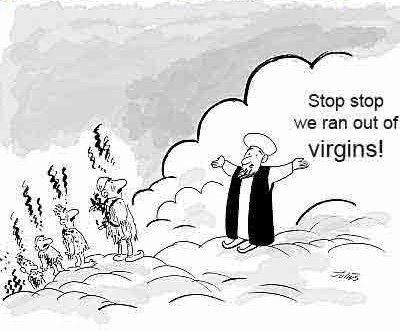
"As for the Muslim Paradise, with its 77 houris per man, all presumably clamouring for attention at the same moment, it is just a nightmare." George Orwell, Tribune, 24 December 1943.
On this, I'm backing Harry's campaign.

Subscribe to:
Posts (Atom)