
29 October 2006

27 October 2006
THINK TANK REBRANDS
Britain's leading ideas factory has adopted a new look in response to unfortunate recent events.

Please feel free to reproduce graphic.

Please feel free to reproduce graphic.
25 October 2006
ONLY A WHOLLY ELECTED SECOND CHAMBER WILL DO
Paul Anderson, Tribune column, 27 October 2006
Call me an old cynic if you will, but I have a sneaking suspicion that no one reacted to last weekend’s leak of Jack Straw’s latest discussion paper on reform of the Lords by exclaiming: “Wow! A 50 per cent elected, 50 per cent appointed second chamber! What a brilliant new idea!”
Because it isn’t brilliant, and it isn’t new. In fact, it was proposed, and rejected by MPs — just as every other option was rejected — last time Lords reform came up, when the late and much-missed Robin Cook was leader of the House of Commons.
What was wrong with it then is what is wrong with it now. In a democracy, the legitimacy of legislators can be rooted only in direct elections. A second chamber that is 50 per cent appointed is by definition not legitimate. And no amount of guff about the need to encourage distinguished people from all walks of life to lend their expertise to the legislative process (see, for example, Max Hastings in Monday’s Guardian) can disguise the fact. If those distinguished people want to play a part in the legislature, they should put themselves up for election — end of story. There really is no democratic alternative.
And of course everyone knows it. Indeed, I suspect that the real reason Straw has resurrected the 50:50 proposal is precisely that a second chamber lacking democratic legitimacy would not be able to challenge the primacy of the Commons. But there is another simple way of ensuring the leading role of the Commons, which is to carefully delineate in law the respective powers of the two houses of parliament. Plenty of other countries do it. There is no good reason Britain can’t do the same.
***
The 50th anniversary of the Hungarian revolution has been marked by a series of features in the Guardian and a very good book by Victor Sebestyen (which I reviewed in Tribune last week) — but I’m a little surprised at how little the left (at least in Britain) has had to say about it.
Hungary 1956 was one of the left’s great watersheds of the 20th century — perhaps not as important as the outbreak of the Great War in 1914 or the Bolshevik revolution of 1917 but certainly up there with the Spanish civil war and the Hitler-Stalin pact. Before the Soviet tanks rolled in to smash the reformist Imre Nagy government and the workers’ councils that had sprung up to defend it, it was just about possible honestly to consider that what was wrong with Soviet communism was down to Stalin’s excesses and that the regime was essentially on the right tracks. (This is not my view of the Soviet Union, need I say.) Afterwards, only fools and liars could praise the Soviet Union as a workers’ state.
Throughout the western world, Hungary caused a mass exodus from communist parties. The Communist Party of Great Britain — never a mass party like the French or Italian communist parties, but nevertheless a significant force on the left — lost one third of its membership, including its most talented intellectuals, most notably the historian and polemicist Edward Thompson. Some ex-communists withdrew into political inactivity, but Thompson and others threw themselves with vigour into creating a New Left that was explicitly anti-Stalinist and socialist.
That New Left fizzled out, but its members remained key players on the British left — as Labour MPs, in the peace movement, as writers — until the late 1980s and early 1990s. Those who are still alive are getting on a bit now, but their role in reviving what had become a moribund British left culture deserves to be marked. We need a few like them today.
***
Now, I know this is controversial but it has to be asked: what exactly do all those people clamouring for rapid British and American withdrawal from Iraq — from Simon Jenkins to George Galloway — think would happen if their demands were met?
Would the Iraqi people, joyous at throwing off the yoke of imperialism, settle down at once to live in peace and harmony? Somehow I have my doubts. The wave of sectarian violence and ethnic cleansing currently sweeping Iraq suggests that a rapid British and American withdrawal would be the prelude to civil war and mass slaughter not unlike the catastrophe of Indian partition in 1947.
That things have come to this pass is certainly at very least an indictment of the British and American governments’ failure to plan what happened after they toppled Saddam. And we can continue to argue about whether it was wrong to topple Saddam at all. But what is important now is that Britain and America, having helped create this almighty mess, do everything they can to avert civil war. And for the life of me I can’t see how they can do anything unless they have large and well equipped armies on the ground in Iraq.
Call me an old cynic if you will, but I have a sneaking suspicion that no one reacted to last weekend’s leak of Jack Straw’s latest discussion paper on reform of the Lords by exclaiming: “Wow! A 50 per cent elected, 50 per cent appointed second chamber! What a brilliant new idea!”
Because it isn’t brilliant, and it isn’t new. In fact, it was proposed, and rejected by MPs — just as every other option was rejected — last time Lords reform came up, when the late and much-missed Robin Cook was leader of the House of Commons.
What was wrong with it then is what is wrong with it now. In a democracy, the legitimacy of legislators can be rooted only in direct elections. A second chamber that is 50 per cent appointed is by definition not legitimate. And no amount of guff about the need to encourage distinguished people from all walks of life to lend their expertise to the legislative process (see, for example, Max Hastings in Monday’s Guardian) can disguise the fact. If those distinguished people want to play a part in the legislature, they should put themselves up for election — end of story. There really is no democratic alternative.
And of course everyone knows it. Indeed, I suspect that the real reason Straw has resurrected the 50:50 proposal is precisely that a second chamber lacking democratic legitimacy would not be able to challenge the primacy of the Commons. But there is another simple way of ensuring the leading role of the Commons, which is to carefully delineate in law the respective powers of the two houses of parliament. Plenty of other countries do it. There is no good reason Britain can’t do the same.
***
The 50th anniversary of the Hungarian revolution has been marked by a series of features in the Guardian and a very good book by Victor Sebestyen (which I reviewed in Tribune last week) — but I’m a little surprised at how little the left (at least in Britain) has had to say about it.
Hungary 1956 was one of the left’s great watersheds of the 20th century — perhaps not as important as the outbreak of the Great War in 1914 or the Bolshevik revolution of 1917 but certainly up there with the Spanish civil war and the Hitler-Stalin pact. Before the Soviet tanks rolled in to smash the reformist Imre Nagy government and the workers’ councils that had sprung up to defend it, it was just about possible honestly to consider that what was wrong with Soviet communism was down to Stalin’s excesses and that the regime was essentially on the right tracks. (This is not my view of the Soviet Union, need I say.) Afterwards, only fools and liars could praise the Soviet Union as a workers’ state.
Throughout the western world, Hungary caused a mass exodus from communist parties. The Communist Party of Great Britain — never a mass party like the French or Italian communist parties, but nevertheless a significant force on the left — lost one third of its membership, including its most talented intellectuals, most notably the historian and polemicist Edward Thompson. Some ex-communists withdrew into political inactivity, but Thompson and others threw themselves with vigour into creating a New Left that was explicitly anti-Stalinist and socialist.
That New Left fizzled out, but its members remained key players on the British left — as Labour MPs, in the peace movement, as writers — until the late 1980s and early 1990s. Those who are still alive are getting on a bit now, but their role in reviving what had become a moribund British left culture deserves to be marked. We need a few like them today.
***
Now, I know this is controversial but it has to be asked: what exactly do all those people clamouring for rapid British and American withdrawal from Iraq — from Simon Jenkins to George Galloway — think would happen if their demands were met?
Would the Iraqi people, joyous at throwing off the yoke of imperialism, settle down at once to live in peace and harmony? Somehow I have my doubts. The wave of sectarian violence and ethnic cleansing currently sweeping Iraq suggests that a rapid British and American withdrawal would be the prelude to civil war and mass slaughter not unlike the catastrophe of Indian partition in 1947.
That things have come to this pass is certainly at very least an indictment of the British and American governments’ failure to plan what happened after they toppled Saddam. And we can continue to argue about whether it was wrong to topple Saddam at all. But what is important now is that Britain and America, having helped create this almighty mess, do everything they can to avert civil war. And for the life of me I can’t see how they can do anything unless they have large and well equipped armies on the ground in Iraq.
20 October 2006
HUNGARY 1956: WORKERS' POWER

Paul Anderson, review of Victor Sebestyen: Twelve Days – Revolution 1956 (Weidenfeld and Nicolson, £20), Tribune, 20 October 2006
The story of the Hungarian revolution of 1956 has been stylishly told before. Two books in particular spring to mind: the British historian Bill Lomax’s Hungary 1956, published in 1976, and Sandor Kopacsi’s In the Name of the Working Class, an eyewitness account by the Budapest police chief who sided with the revolutionaries, which was translated into English in 1986.
What Victor Sebestyen manages in his new history, however, is to tell the story with verve at the same time as explaining for a post-cold-war readership the international context of the extraordinary events of October-November 1956, when an overwhelmingly working-class uprising came within a whisker of overthrowing a Soviet-imposed Stalinist dictatorship.
In Sebestyen’s account, the roles of Nikita Khruschev, general secretary of the Communist Party of the Soviet Union, and Dwight D Eisenhower, president of the United States, are – rightly – as important as those of Imre Nagy, the reformist Hungarian prime minister from 24 October to 4 November 1956, or indeed of any other Hungarian. It was Khruschev’s insistence on showing the Hungarians who was boss and Eisenhower’s refusal to do anything that might risk war that determined the revolution’s fate – its brutal suppression by Soviet invasion.
The revolutionaries resisted the tanks with petrol bombs and rifles, and the workers’ councils that were such a notable feature of the revolution continued to organise strikes and demonstrations long after ceding control of the streets to the occupiers. But their leaders were arrested and imprisoned and Hungary returned to communist dictatorship under the opportunist Janos Kadar, who remained in power until 1988. Nagy and his closest comrades were executed in 1958.
What the revolution might have turned into if Khruschev had left it to its own devices cannot of course be known. Sebestyen makes less of the role of the workers’ councils than Lomax and others, which to my mind is a shame. This was a self-managed proletarian revolution above all else, and it is not too fanciful to believe that it might just have created a pluralist, egalitarian, decentralised, self-managed socialist society.
But never mind. If Sebestyen doesn’t speculate about the potential of the workers’ councils, it is nevertheless clear from his account that the overwhelming majority of Hungarian revolutionaries wanted at very least some form of democratic socialism rather than a return to capitalism. The communist claim that the revolution was an attempt by fascists to seize power was, quite simply, a slanderous lie.
Could anything have prevented the defeat of the revolution? Perhaps if the west had threatened military action in support of the revolution, Khruschev would have been forced to back down. But the west was in no position credibly to threaten military action – the Hungarian revolution coincided with the debacle of Suez, which tore the Atlantic alliance asunder – and, of course, the Soviets had the bomb.
Sebestyen was born in Budapest and was a small child when his family left Hungary after 1956 as refugees. A respected journalist in Britain, he has a great feel for the politics of the 1950s and writes in a terse demotic style. This is an exemplary work of popular history that deserves a wide readership.
... BUT NOT TOO BUSY FOR THIS
Very pleasant to meet you, Louise and Stroppybird, without your catsuits on ... and with Dave and Lady M and the others there too it almost turned into the nearest thing I've seen to ...
I then made my excuses and left.
I then made my excuses and left.
17 October 2006
13 October 2006
BIRDS IN CATSUITS
The comrades at Stroppyblog have taken my advice ... almost. Stunning redesign by Will.
HOW ABOUT THIS?
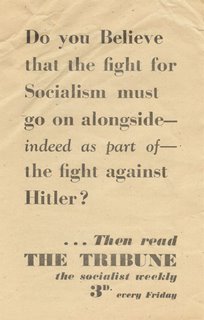
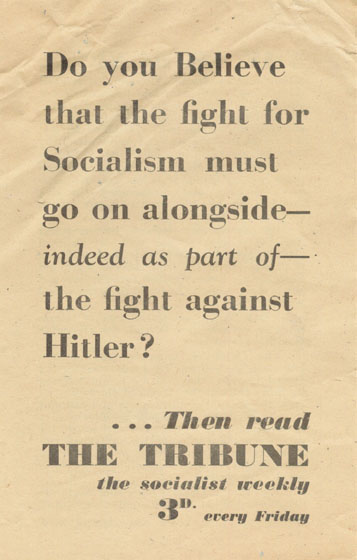
I've just found this flier for Tribune from early 1941 – when the Nazi-Soviet pact was in force. Good, eh?
LET THEM GET ON WITH IT
It is clear we need to get out of Iraq. Them Arabs just want to kill each uvver — innit guvnor? It's none of our business. Let em get on wiv it. Nuffink to do wiv us. Let em kill emselves, who cares, bloody Arabs, eh, guvnor?
11 October 2006
ON THE BALL
As usual, local and regional journalists hit the story before the nationals. What is the most important book de nos jours? Forget the Booker, it's mine, and thanks to Steve Russell of the East Anglian Daily Times and Bridget Galton of the Ham and High (can't find the piece on Google), the people of Ipswich and Hampstead know it already. Thank you and I owe you both a drink.
7 October 2006
5 October 2006
DRUNKEN LEFTIST EVENT IN FITZROVIA
Just back home from my Orwell in Tribune bash at the Wheatsheaf, which went really well apart from my pathetic attempt at a speech. It was great to see you all, I'm sorry I wasn't able to talk to anyone at length, and thanks everyone for coming. I've covered costs for beer and books and if the IOUs are honoured the Tribune Fighting Fund will be better off by a couple of hundred quid. Good night, and I love you all!
1 October 2006
BOOGALOO DUDES
Hak Mao has found some excellent You Tube of Mott the Hoople and Iggy. Busy sad old fart that I am, I've not yet worked out how to post video properly. But I did "I Wanna be Your Dog" more than once live many years ago. And "Search and Destroy", while we're at it. And "All the Way to Memphis" and ... oh, shut up!
30 September 2006
MY ADVENTURES IN A GORILLA SUIT WITH JEANETTE WINTERSON
The news that the novelist Jeanette Winterson is to appear on the platform at the Tory conference next week marks a first in my life. Never before, as far as I am aware, has an old friend addressed a Conservative conference.
OK, I mean old friend in the sense of friend from some time back: I haven’t seen her since the launch of Oranges Are Not the Only Fruit, her first novel, more than 20 years ago, and I still think of her as Jan. But at university and for a while afterwards we were good mates. I shared a house with her, her then partner and a couple of others in Crotch Crescent (after Mrs Crotch the hymn writer, I believe) off Marston Road in Oxford in 1979-80, and I have fond memories of going to Staithes, near Robin Hood’s Bay, with her and another friend for a holiday.
She also gave me a bit part in a student production of Cabaret she directed, which ended up on the Edinburgh fringe (without me, I hasten to add).
For this spectacular, which as I remember was very poor apart from the singing of the lead characters, I had to do a dance in drag in a gorilla suit while peeling a banana.
Well, actually, it wasn’t a gorilla suit, because we couldn’t afford more than the mask: I had to fake an all-over suit by sticking black fur to an old pair of wellies and making a rudimentary pair of arm-length black furry mittens. (The dress covered up the rest.) The problem was that it was impossible to peel the banana with the mittens on – which I discovered only on the first night, as the audience howled in derision.
But I digress. The point is that the dancing gorilla in drag was being set up for something nasty. As I pranced like Walter the Softy and desperately attempted to peel the banana, the MC sang a song that started: “If you could see her through my eyes, you wouldn’t wonder at all…” and ended: “If you could see her through my eyes, she wouldn’t look Jewish at all!”
This was the cue for Nazi stormtroopers to invade the stage, rip off my gorilla mask and kill me. I then had to play dead while everyone else got on with the show, for what seemed like a lifetime.
I hope Jeanette has better luck with the Tories next week.
OK, I mean old friend in the sense of friend from some time back: I haven’t seen her since the launch of Oranges Are Not the Only Fruit, her first novel, more than 20 years ago, and I still think of her as Jan. But at university and for a while afterwards we were good mates. I shared a house with her, her then partner and a couple of others in Crotch Crescent (after Mrs Crotch the hymn writer, I believe) off Marston Road in Oxford in 1979-80, and I have fond memories of going to Staithes, near Robin Hood’s Bay, with her and another friend for a holiday.
She also gave me a bit part in a student production of Cabaret she directed, which ended up on the Edinburgh fringe (without me, I hasten to add).
For this spectacular, which as I remember was very poor apart from the singing of the lead characters, I had to do a dance in drag in a gorilla suit while peeling a banana.
Well, actually, it wasn’t a gorilla suit, because we couldn’t afford more than the mask: I had to fake an all-over suit by sticking black fur to an old pair of wellies and making a rudimentary pair of arm-length black furry mittens. (The dress covered up the rest.) The problem was that it was impossible to peel the banana with the mittens on – which I discovered only on the first night, as the audience howled in derision.
But I digress. The point is that the dancing gorilla in drag was being set up for something nasty. As I pranced like Walter the Softy and desperately attempted to peel the banana, the MC sang a song that started: “If you could see her through my eyes, you wouldn’t wonder at all…” and ended: “If you could see her through my eyes, she wouldn’t look Jewish at all!”
This was the cue for Nazi stormtroopers to invade the stage, rip off my gorilla mask and kill me. I then had to play dead while everyone else got on with the show, for what seemed like a lifetime.
I hope Jeanette has better luck with the Tories next week.
29 September 2006
HEADLESS CHICKENS NOT SHOOTING THEMSELVES IN THE FOOT – 1
Congratulations to the Labour Party on a successful conference. I'm with Anatole Kaletsky here, who makes several pertinent points about the outbreak of unity in Labour ranks – and about the extraordinary vacuity of the party's thinking on just about everything. Alice Miles, whose picture byline is the sexiest of anyone's in the national press simply because her glasses are not on straight – total geeky babe or what? – adds to the case here. Call me what you like, but the Murdoch press is increasingly the place where the Labour story is being told as it is.
27 September 2006
26 September 2006
GORDON WAS OK
The boy done Gordon as we've always known him. He's as clumsy as ever as a speaker but sincere and serious. "Freeedom, decency, fairness ... common standards of citizenship and common rules ... and I've met many of them ... a shared national purpose for our country ... and let me say this ... I'm proud to be Scottish and British ... and I've met many of them ... together we defeated fascism and built the NHS .. . and let me say this ... thousands of chances to expand young people's horizons ... we, the Labour government share your concerns... and let me say this ... we are doubling public investment in social housing ... no longer a Britain of them and us ... and I've met many of them ... but a Britain of we the people working together ... the empowerment of local councils is what we must now do ... and I've met many of them ... and let me say this ... Britain cannot lead the world by standing still ... all the talents of our country ... a progressive future that is still to be built ... and let me say this ... poverty of opportunity and poverty of aspiration ... and I've met many of them ... there is a vision of the good society ... more prosperous and secure ... and I've met many of them ... we will never lose sight of your aspirations ..."
He'll do.
He'll do.
22 September 2006
COLUMNIST OF THE CENTURY
Paul Anderson, Tribune column, 22 September 2006
No British writer of the past 100 years has a greater reputation as a journalist than George Orwell. His three great books of reportage, Down and Out in Paris and London, The Road to Wigan Pier and Homage to Catalonia — although not perhaps as ubiquitous as his two best known novels, Animal Farm and Nineteen Eighty-Four — are the only examples of British journalism from the 1930s now in print in popular editions. Every other journalist I meet, from foreign correspondents to sub-editors, says that Orwell was a major inspiration.
Yet Orwell’s journalism, or at rather his everyday journalism, is not as widely read as it deserves to be. Unless you have worked your way through the final ten volumes of Peter Davison’s magisterial 20-volume Complete Works of George Orwell, published in the late 1990s, you are unlikely to have taken in more than a tiny sample of the journalistic writing Orwell did in the last 20 years of his life.
Everything is in Davison, of course, but it is spread through more than 5,000 pages, interspersed with letters and fascinating ephemera. There was a generous selection of Orwell’s journalism published in four volumes in the 1960s as Collected Essays, Journalism and Letters, edited by Ian Angus and Orwell’s widow Sonia, but Sonia kept out a lot because it was too political for her tastes. In the 1980s, the New Statesman produced a slim pamphlet of Orwell’s contributions to its pages and the writer W. J. West edited two volumes of Orwell’s broadcast scripts for the BBC in 1941-43. And a couple of years ago came a collection of his reviews and reportage in the Observer.
Until this week, however, there was a glaring gap. The routine journalism on which Orwell’s reputation is primarily based is not his work for the BBC or the Observer, let alone his half-dozen reviews for the New Statesman, whose editor, Kingsley Martin, he hated. Rather it is his columns for Tribune, 80 of which appeared under the rubric “As I Please” between 1943 and 1947. And now, thanks to Politico’s Publishing, they are all available in a single volume, Orwell in Tribune: “As I Please” and other writings, with a foreword by Michael Foot and an introduction by me.
I first realised they would make a fantastic book 20 years ago, when I started working as Tribune’s reviews editor. I was already a big Orwell fan — one of the main reasons I went for the job was that Orwell did it from 1943 to 1945 — and my office at the paper contained the bound volumes of back issues. I spent hours poring over the yellowing pages, admiring Orwell’s direct demotic writing style and his extraordinary range of subject matter.
But simply to transcribe all the columns would have taken money Tribune didn’t have or time I didn’t have, and I never got further than dreaming. Ten years ago, after the New Statesman sacked me, I suddenly found myself with time on my hands and even got a proposal together — but then another job turned up. It was only last year I decided to try to get a publisher. Chris McLaughlin, the Tribune editor, mentioned the project to Politico’s, and all of a sudden I had a contract and a deadline.
I underestimated how much time the book would take even with accurate optical character recognition software: I spent the heatwave in July proofreading rather than sitting by a pool. But now it’s out, all the effort feels worth it.
Despite the diversity of their subject matter, Orwell’s Tribune columns form a single coherent body of work. In the words of the critic D. J. Taylor in his recent Orwell biography: “One of the most engaging features of the column, read sequentially, is the sense of dialogue, points taken up, conceded or refuted, continuity rather than a trail of pronouncements which the reader could take or leave as he or she chose.”
The columns are also still remarkably relevant. If there is a single theme that runs all the way through them, it is that the left needs a more nuanced conception of politics. And this emphasis on the things the left habitually ignored — books, sport, popular racism, the sensationalism of the popular press, the slipperiness of political language, religious intolerance — rather than the programmatic core of 1940s democratic socialism or the week-by-week flow of events, makes Orwell’s Tribune columns more accessible than anything written by his contemporaries.
I’m also hoping that the book will make a bit of cash for Tribune. The paper holds copyright on the Orwell it published but has never made a penny from it, giving away permissions to republish whenever asked. Now, with a bit of luck, it should at long last benefit materially from its greatest contribution to the world of letters.
Orwell in Tribune: “As I Please” and other writings, compiled and introduced by Paul Anderson with a foreword by Michael Foot, is published by Politico’s at £19.99. You can buy it here.
No British writer of the past 100 years has a greater reputation as a journalist than George Orwell. His three great books of reportage, Down and Out in Paris and London, The Road to Wigan Pier and Homage to Catalonia — although not perhaps as ubiquitous as his two best known novels, Animal Farm and Nineteen Eighty-Four — are the only examples of British journalism from the 1930s now in print in popular editions. Every other journalist I meet, from foreign correspondents to sub-editors, says that Orwell was a major inspiration.
Yet Orwell’s journalism, or at rather his everyday journalism, is not as widely read as it deserves to be. Unless you have worked your way through the final ten volumes of Peter Davison’s magisterial 20-volume Complete Works of George Orwell, published in the late 1990s, you are unlikely to have taken in more than a tiny sample of the journalistic writing Orwell did in the last 20 years of his life.
Everything is in Davison, of course, but it is spread through more than 5,000 pages, interspersed with letters and fascinating ephemera. There was a generous selection of Orwell’s journalism published in four volumes in the 1960s as Collected Essays, Journalism and Letters, edited by Ian Angus and Orwell’s widow Sonia, but Sonia kept out a lot because it was too political for her tastes. In the 1980s, the New Statesman produced a slim pamphlet of Orwell’s contributions to its pages and the writer W. J. West edited two volumes of Orwell’s broadcast scripts for the BBC in 1941-43. And a couple of years ago came a collection of his reviews and reportage in the Observer.
Until this week, however, there was a glaring gap. The routine journalism on which Orwell’s reputation is primarily based is not his work for the BBC or the Observer, let alone his half-dozen reviews for the New Statesman, whose editor, Kingsley Martin, he hated. Rather it is his columns for Tribune, 80 of which appeared under the rubric “As I Please” between 1943 and 1947. And now, thanks to Politico’s Publishing, they are all available in a single volume, Orwell in Tribune: “As I Please” and other writings, with a foreword by Michael Foot and an introduction by me.
I first realised they would make a fantastic book 20 years ago, when I started working as Tribune’s reviews editor. I was already a big Orwell fan — one of the main reasons I went for the job was that Orwell did it from 1943 to 1945 — and my office at the paper contained the bound volumes of back issues. I spent hours poring over the yellowing pages, admiring Orwell’s direct demotic writing style and his extraordinary range of subject matter.
But simply to transcribe all the columns would have taken money Tribune didn’t have or time I didn’t have, and I never got further than dreaming. Ten years ago, after the New Statesman sacked me, I suddenly found myself with time on my hands and even got a proposal together — but then another job turned up. It was only last year I decided to try to get a publisher. Chris McLaughlin, the Tribune editor, mentioned the project to Politico’s, and all of a sudden I had a contract and a deadline.
I underestimated how much time the book would take even with accurate optical character recognition software: I spent the heatwave in July proofreading rather than sitting by a pool. But now it’s out, all the effort feels worth it.
Despite the diversity of their subject matter, Orwell’s Tribune columns form a single coherent body of work. In the words of the critic D. J. Taylor in his recent Orwell biography: “One of the most engaging features of the column, read sequentially, is the sense of dialogue, points taken up, conceded or refuted, continuity rather than a trail of pronouncements which the reader could take or leave as he or she chose.”
The columns are also still remarkably relevant. If there is a single theme that runs all the way through them, it is that the left needs a more nuanced conception of politics. And this emphasis on the things the left habitually ignored — books, sport, popular racism, the sensationalism of the popular press, the slipperiness of political language, religious intolerance — rather than the programmatic core of 1940s democratic socialism or the week-by-week flow of events, makes Orwell’s Tribune columns more accessible than anything written by his contemporaries.
I’m also hoping that the book will make a bit of cash for Tribune. The paper holds copyright on the Orwell it published but has never made a penny from it, giving away permissions to republish whenever asked. Now, with a bit of luck, it should at long last benefit materially from its greatest contribution to the world of letters.
Orwell in Tribune: “As I Please” and other writings, compiled and introduced by Paul Anderson with a foreword by Michael Foot, is published by Politico’s at £19.99. You can buy it here.
Subscribe to:
Posts (Atom)