28 September 2013

IT'S SELLING LIKE LUKEWARM BUNS!

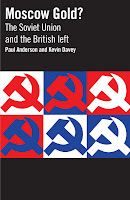
Here's the Amazon sales ranking for Moscow Gold? The Soviet Union and the British left by Paul Anderson and Kevin Davey. Buy it now!

NICK COHEN says:

'Moscow Gold? The Soviet Union and the British left by Paul Anderson and Kevin Davey is a fine little book you can read in a day – 168 pages for just £3.50 on Kindle. Anderson and Davey have taken advantage of the vast amount of research into communism since the end of the Cold War. They wear it lightly, and refreshingly, are open about their political position. As members of the democratic left, they believe that communism was a disaster for left wing politics. It tied the left to tyranny and the lies and disillusion that went with it.'

26 September 2013

THE COMRADES STRIKE BACK

Ian Bone, late of Class War, gives a plug to Moscow Gold? The Soviet Union and the British left on his blog. It didn't go down well. The first comment, from "EUSTONED? aint we all" reads:

'Nick Cohen says: "A fine little book that reveals Stalin’s deathbed plans to subvert the decent British left for the next 60 years. Chapter five suggests that 'Owen Jones' is really Olga Jonovitch, the crazed Islamo-fascist creation of the KGB’s secret mind labs, programmed to murder Ed Miliband and establish a Victor Serge-Billy Braggist 'volk' dictatorship and the mass-production of bright red three-wheel Lada cars. I call on every decent left liberal opinion-former to read this book, subscribe to Tribune, bomb Iraq and inform on your mates. If you have any. AND ask yourself: 'What would Orwell do? And his animals?'"

Marvellous!

25 September 2013

PEOPLE SHOULD BUY THIS BOOK


NICK COHEN says:

'Moscow Gold? The Soviet Union and the British left by Paul Anderson and Kevin Davey is a fine little book you can read in a day – 168 pages for just £3.50 on Kindle. Anderson and Davey have taken advantage of the vast amount of research into communism since the end of the Cold War. They wear it lightly, and refreshingly, are open about their political position. As members of the democratic left, they believe that communism was a disaster for left wing politics. It tied the left to tyranny and the lies and disillusion that went with it.'

7 September 2013

AV IS NOT PR ...

I know this is hardly the question of the moment in the UK, but the way the Australian general election is panning out does show how the alternative vote – preferential voting in single-member constituencies – can lead to landslides even more unproportional than those that often happen under first past the post. The exit polls suggest a right-left percentage share of the vote of 53-47 but a right-left percentage share of seats of roughly 66-33.

OBITUARY: GEOFFREY GOODMAN

I'm sad to hear of the death of Geoffrey Goodman, the left-wing journalist who was one of the greatest supporters of and contributors to Tribune, at the age of 91. I never knew him well, but he did reviews for me at Tribune and we met over lunch at the Gay Hussar many times in the company of others. He was a legend – a veteran of the Communist Party (which he left in 1951 over Tito, I think, though others have it as 1956 over Hungary), the Bevanite movement, the News Chronicle of the 1950s, the Daily Herald and Odhams' Sun in the 1960s, the Daily Mirror in its 1970s "golden age", one of the labour correspondents that were must-reads when trade unions mattered a lot – and he was a fantastic writer and very kind. There's an obituary in the Guardian by Mike Molloy here, with an appreciation by Ian Aitken here. Dennis Kavanagh's warm obituary in the Independent, here, includes a howler that Goodman would have picked up with glee (note to Independent subs: it was the Daily Mail that took over the News Chronicle). Here is the Mirror's tribute. RIP.

5 September 2013

PROPER IMPERIALISM IS NOT ON THE AGENDA

Tribune column, 6 September 2013

The fall-out from last Thursday’s House of Commons defeat for David Cameron over military intervention in Syria has been spectacular. The newspapers and current affairs broadcasters have had a week of field days as the various political protagonists have laid into one another and pundits have tried to grasp the significance of the vote. Is Cameron finished? Is Ed Miliband an opportunist toe-rag? Is this the end of the special relationship?

Largely sidelined by the furore, however, has been any serious concern for the substantive issue supposedly at stake – what if anything the rest of the world should do about the civil war in Syria, in which some 100,000 people have died, 2 million have fled the country as refugees and 4 million have become displaced persons within its borders.

Of course, that’s not an easy question to answer. Although the internet is awash with images of atrocities, it is by no means clear exactly what is happening in Syria except that it’s bloody and unpleasant. There are conflicting reports about the strength and nature of the opposition to Bashar al-Assad’s regime: some say it’s still largely composed of moderate Sunnis who would be quite happy to live in harmony with everyone else, others that it is now dominated by murderous jihadists with strong al-Qa’ida connections. It’s not obvious how far Assad is now reliant on support from Iran and its Lebanese surrogate Hezbollah – rather more important regional players than his friends in Moscow, who have been grandstanding for all they are worth as well as supplying him with arms – and we don’t know how far the opposition is serving the interests of Riyadh, Doha and Ankara. As I write, it’s not even beyond question that it was the regime and not agents provocateurs that unleashed the nerve gas massacre that brought about last week’s call to action from Cameron (and I’ve not succumbed to conspiracy theory, honest).

It’s possible that the intelligence agencies of the world know a lot about the situation on the ground of which journalists are wholly unaware, but even if they do that’s not the end of the problem. The strong opposition of Russia and China to any sort of international intervention against Assad might well be more a matter of cynical self-interest than a statement of anti-imperialist principle, but it rules out the possibility of United Nations endorsement of even the most minimal “shots across the bow”. Israel is a wild card, utterly unpredictable because driven by hostility both to Assad and his enemies. Egypt is more-or-less under martial law after the coup against the Muslim Brotherhood; Iraq is out of the headlines but seething with sectarian tensions. And public opinion in the US and the UK is sceptical about the claims of the political class that intervention will work: memories are fresh of Afghanistan and Iraq, where successful regime-changing assaults were followed by years of bloody counter-insurgency operations. An invasion of Syria that learnt the lessons of Afghanistan and Iraq – Germany 1945-style, with regime-change, forcible disarmament of the population, an occupation involving hundreds of thousands of troops, the securing of borders and all the rest – would probably do the business, but “boots on the ground” are the last thing any western politician could now sell to an electorate. Proper imperialism is not on the agenda.

Which means that the people of Syria will continue to suffer in agony as humanitarians and liberals in the west wring their hands. The most that Barack Obama will sanction, as things stand, is a no-fly zone, and that’s assuming Congress gives him its backing. It won’t work, and will lead to lots more innocent people being killed.

Last week in the House of Commons, MPs refused to back something even more minimal. I can understand why, though I have no sympathy with the Tory and Liberal isolationists who can’t be bothered with quarrels in faraway countries between people of whom they know nothing. And it matters, because it creates a crisis of authority for the British government and marks a change in Britain’s perception of its role in world affairs. It makes very little difference, however, to what happens in Syria. If I were a Syrian, I think I would probably have a lot to say about that.

23 July 2013

SOLIDARITY FOREVER

I've just discovered that the comrades at libcom.org have scanned the libertarian socialist magazine Solidarity for Social Revolution from the late 1970s and early 1980s and put it online. The last few issues include quite a bit from me, much of which is rubbish. I also did a lot of the production work. Am I embarrassed? Not at all! It's here in all its glory ...

22 July 2013

THE BABY WILL BE CROWNED AS A PENSIONER

Now, I hate to do this but … the royal baby is rather a long way distant as king or queen unless the proverbial bus does its business.

The new baby is third-in-line to the throne, after his great grandma, his granddad and his daddy.

This lot have got to die first:

  • HM the Q (1926-)
  • Prince Charles (1948-)
  • Prince William (1982-)

  • Now, given the longevity of the royal family and the quality of their private health care, it’s not mad to suggest that Prince William will die in 2083. That means that the sprog accedes to the throne at the age of 70 and rules at the end of the 21st century. O frabjous day! Callooh! Callay!

    Why not put this nonsense to sleep?

    12 July 2013

    TIME TO LOOK TOUGH?

    Paul Anderson, Tribune column, 12 July 2013

    The giant bust-up over Labour’s parliamentary selection in Falkirk has eclipsed everything else in British politics for the past couple of weeks – and Labour’s relationship with the trade unions has the potential to escalate into the story that dominates the summer and the conference season.

    And of course it matters – just as it mattered last time it became the really hot issue, 20 years ago, when Labour went through months of hell arguing the toss about John Smith’s attempt to introduce the principle of “one member, one vote” to internal Labour elections while continuing to allow affiliated unions a key role in the party’s organisation. Smith got his messy compromise through in the end, but it was only at the very last minute after some desperate behind-the-scenes conference fixing. It made for marvellous high drama, and the settlement reached in 1993 proved much more resilient than seemed likely.

    How much the whole hoo-hah really changed is another question, however – and Labour’s preoccupation with its own structures undoubtedly diverted it from more important things. I have a feeling that the same might be about to happen now, if it’s not already happening.

    Until Falkirk came along, the shadow cabinet was obviously attempting to get into pre-election mode. Last month’s speeches by Ed Miliband and Ed Balls accepting that an incoming Labour government in 2015 would have to stick to the coalition’s budget for a year were followed by a lacklustre intervention by the shadow education secretary, Stephen Twigg, in which he announced that Labour would not do anything against “free schools”, though it wouldn’t actually promote them.

     Last week was supposed to be when Labour made it clear that it wasn't actually against a referendum on British membership of the European Union – though it wasn’t exactly in favour of one either. The party just about got the point across because someone left a briefing paper in the gents’ that was subsequently published by a right-wing blogger (or am I mixing this up with something else?). But thanks to Falkirk it made only the online equivalent of a paragraph on page nine.

    Now, a cynic might suggest that Labour’s attempts to deal with the important issues have been so utterly hopeless that the confrontation with Len McCluskey is a welcome opportunity for Miliband to prove he can make tough decisions, and that he should now pull out all the stops to push through radical changes to Labour’s constitution.

    I’m not so sure – and not just because I’d like to see Labour coming up with some bold alternative policies rather than turning inwards. One problem is timing. A giant internal constitutional battle is all very well for an opposition party in the first year of a parliament – it can even be cathartic – but is very dangerous less than two years from a general election, particularly when it’s only now that proposals are being tabled.

    Miliband this week made it clear that he wants to move from opting out of Labour for union payers of the political levy to opting in, primaries for the London mayor selection and other selections, an overall cap on political donations – much of which makes sense in principle but, as OMOV showed 20 years ago, the devil is in the detail with this sort of thing, and there’s not a lot of time to sort it out.

    The real problem, however, is it that it’s by no means clear that Miliband will win on the terrain on which he has chosen to fight. And if he loses, his credibility will be utterly destroyed. He has got his work cut out.

    Not for the first time, I’m glad I’m not in the Labour leader’s shoes. Oh well. The sun is out and the sky is blue, and it’s nearly holiday time. And a Scotsman has won the men’s singles at Wimbledon for the first time since 1896. It’s not all completely depressing, is it?

    5 July 2013

    SORTING FALKIRK

    Some points about the great Falkirk controversy (I was going to write about it in my Tribune column next week, but forget that):
    1. It is distasteful if a close friend of a general secretary of a trade union that is Labour’s largest funder is vigorously promoted by that union as a potential candidate for a safe Labour seat.
    2. It is wrong if the promotion of that would-be candidate involves the union paying for large numbers of its members and people its organiser met down the pub to join the Labour Party solely to vote for the would-be candidate.
    3. It is worse still if that would-be candidate is employed by a Labour Party general election co-ordinator who is also a friend of the trade union general secretary.
    4. It becomes ridiculous if the trade union general secretary’s chief of staff is a member of the hard-line Stalinist Communist Party of Britain, if he himself was very close to the Trotskyist Militant Tendency, and if his union has openly adopted a policy of recruiting members in order to get hard-left candidates sympathetic to the Stalinists and Trots selected.
    5. It turns into farce if the main alternative "New Labour" candidate is the partner of an MP in the shadow defence secretary’s team and a major player in the Labour Party’s communications outfit.
    6. It becomes totally ludicrous if the alternative candidate also paid for people to join the constituency Labour Party in order to secure selection votes.
    7. It gets utterly barmy if the shadow defence secretary then has a go at the union general secretary…
    8.  … and barmier if the union general secretary has a go back ...
    9.  … and barmier still if the press gets involved, and then the leader of the Labour Party and everyone who has an opinion about politics take the bait and it’s all over the media.
    10. It is solved by various people leaving the scene.
    The general election co-ordinator is a start. The shadow defence secretary and the trade union general secretary’s chief of staff would, for example, be small sacrifices to the cause. Otherwise, it's stuffed.

    26 June 2013

    13 June 2013

    WHERE IS THE VISION?

    Paul Anderson, Tribune column, 15 June 2013

    The two big policy speeches by Ed Miliband and Ed Balls last week have not transformed the political landscape.

    No one outside the political class noticed them – and the reaction within the political class was low-key and predictable. The usual suspects said the usual things. The far left and the Tory right proclaimed that Miliband and Balls had performed a U-turn to adopt the policies of the coalition government – committing Labour to austerity and abandoning the principle of universalism in the welfare state. Hardline Blairites sniffed at the failure of the two Eds to take a truly tough position on reducing government debt and pruning the welfare bill: they had shown they were was still beholden to the trade unions and left-wing activists who got Miliband elected as leader in 2010, and there was nothing of substance in what they said.

    So has Labour embraced austerity or not? Actually, it has done neither and both. What happened last week was that Labour shifted into pre-election mode. After two-and-a-half years of repeatedly making the point that Labour wouldn’t have started from here, the party leadership is now talking about what it will do if it wins in 2015. Like it or loath it, by then we will have had five years of coalition austerity – and the room for manoeuvre for an incoming Labour government will be severely constrained. Miliband and Balls were simply relaying the message that if they win they won’t go mad, the very first prerequisite of a successful general election campaign.

    Some say that it’s not before time for Labour to present itself as an alternative government, others that the Eds have moved too soon – that the economy and politics are in such flux, the next two years so unpredictable, that firming up Labour’s programme now will create big hostages to fortune. For what it’s worth, I think they’ve timed it about right. Until very recently, there was at least the possibility of a government U-turn on austerity or a debilitating split in the coalition, which made the lightness of Labour’s baggage an advantage. It now seems that George Osborne intends to stick to his script, and the coalition appears robust enough to survive until 2015 – though it might not – so it makes sense for Labour to get its act together.

    Whether the messages the two Eds have chosen to highlight are the right ones is another matter. “We’ll not splash out on the social security budget and we’ll keep a strict watch on overall public spending” is not the stuff to set the pulse racing – and there wasn’t much else beyond Balls’s cack-handed indication that some universal benefits enjoyed by pensioners would be means-tested.

    Miliband’s hint that Labour will come up with ways to revitalise the contributory element in social security benefits is a step in the right direction, as is his identification of housing benefit as a scandalously wasteful subsidy to petty rentier capitalists (as his dad would have described them). But he didn't flesh out what Labour would actually do about either. Are we talking a return to earnings-related unemployment benefit as it existed in the 1970s – or an extra 25 quid a week for people who have worked 30 years and are made redundant? Is it strict rent controls and a three-year emergency programme of putting up council pre-fabs – or is it tax-breaks for the construction industry to build blocks of luxury flats with the odd “affordable” broom cupboard with a view of the car park?

    OK, I’m not really expecting a return to earnings-related dole, and there are problems with enforcing rent controls. But if Labour is saying that it is going to have to deal with the circumstances it inherits from this disastrous government in 2015, it needs to leaven the dour – it’s going to be tough – with a compelling story of how it could be different.

    So far, the vision thing is absent: Labour looks and sounds timid and unadventurous, driven by focus groups and opinion polls that tell it to play safe. Labour won in 1997 on “safety first”, but things are different now. We’re in the middle of the worst depression since the 1930s, and there is a sullen anti-immigrant, anti-Europe, anti-scrounger mood among the voters that cannot be ignored. Labour needs to offer hope, and it isn’t doing it.

    7 June 2013

    TORTURE IN KENYA: SHOCK REVELATIONS

    "In the heart of the British Empire there is a police state where the rule of law has broken down, where the murder and torture of Africans by Europeans goes unpunished and where the authorities pledged to enforce justice regularly connive at its violation."
    Barbara Castle, Tribune, 30 September 1955

    29 May 2013

    A LATE RECOMMENDATION

    I had Alex Butterworth's The World That Never Was: A True Story of Dreamers, Schemers, Anarchists and Secret Agents (Vintage, 2011) on my pile of books to read for some time. I've now just read it: a page-turner, a quite brilliant piece of work about the European left between the Paris Commune and the first world war. Read it for yourselves: stunning.

    16 May 2013

    CAMERON'S UKIP PICKLE

    Paul Anderson, Tribune column, 17 May 2013

    The extraordinary surge in support for UK Independence Party in the local elections has undoubtedly been the big British politics story of the month. UKIP came from (almost) nowhere to take a surprisingly large share of the vote in the shire counties and unitary councils voting this year and increased its number of council seats by 139.

    Precisely how big its share was is still unclear. The BBC’s figure for UKIP’s “projected national share” of the vote as 23 per cent is what made the headlines – but that is just a little problematic because it is an estimate of what would have happened across the country in local elections if they had taken place everywhere and if UKIP and the three main parties had been contesting every seat. It could be that the BBC’s psephologists built a very sophisticated model to make their projection, but their assumptions have not been published and nor, so far, have the raw data for votes actually cast. I might be wrong, but my hunch is that they have probably exaggerated the evenness of the distribution of UKIP support across the country: UKIP’s actual seats are concentrated in the east and south-east in run-down coastal towns and in agricultural areas where there are lots of east European vegetable-pickers. We shall see.

    Still, UKIP undoubtedly did very well – and that has sent much of the Tory party into a state of panic. Tory MPs could live with the prospect of UKIP getting the most votes in next year’s European elections, but until this month UKIP’s successes in any other elections were minor. It had a tiny number of council seats and, although it had been runner-up in a handful of parliamentary by-elections, in all apart from Eastleigh its second places had been distant. Now the fear has swept the Tories that UKIP will split the right-wing vote in the 2015 general election and let Labour through the middle.

    It might happen, it might not: the general election is a long way off. What is important, however, is that the Tories’ fear is affecting their behaviour in the here and now. UKIP does not have coherent policies for government, and Nigel Farage is difficult to take seriously as a national political leader. But on one issue above all UKIP addresses directly the concerns of a large number of working-class and lower-middle-class voters who mainly voted Tory in 2010: immigration. That much was known before the local elections – the anti-immigration measures in last week’s threadbare Queen’s Speech were not dreamed up in desperation over the previous weekend – but the Tories are in shock at having lost so much of the anti-immigrant electorate, and their ugly chauvinist rhetoric is already getting uglier.

    The government’s problem here is that, as UKIP never tires of pointing out, there is very little it can do to deter anyone from other European Union countries coming to Britain as long as we remain in the EU, and the government does not want to leave. It is difficult to see how David Cameron can get out of this one. He has already promised as much as he can – a renegotiation and the promise of an “in-out” referendum in the next parliament – that is tolerable to his Liberal Democrat coalition partners, but it is not enough for the hardline Tory Eurosceptic right. Cameron now faces trouble on Europe every bit as serious as the endless bickering that undermined John Major during the 1990s.

    Labour can enjoy the Tories’ predicament – but only a little. Its local election campaign was well targeted on marginal Westminster seats, but it too took a hit from UKIP, and its overall share of the vote was unimpressive. More important, it is going to be much more difficult than in the 1990s for Labour to exploit a giant bust-up on the right about Europe. Back then, the economy was booming, immigration meant asylum-seekers, and the right’s anti-Europeanism was all about Brussels bureaucracy rather than east Europeans coming over here and taking our houses and jobs. Labour cannot ignore voters’ worries about immigration and Europe, but it needs to be very careful that it is not sucked into an anti-Europe, anti-immigrant bidding war.

    17 April 2013

    THATCHER WAS A FAILURE

    Paul Anderson, Tribune column, 19 April 2013

    The death of Margaret Thatcher has prompted a wave of public controversy that is quite extraordinary – if only because she had not been a player in British politics for so long. She left office in 1990 and had only a minor role after that – notably in criticising her successor as prime minister, John Major, for his failings on former-Yugoslavia (on which she was right) and the European Union (on which she was wrong). No one now under the age of 43 voted in a general election in which she was a candidate; no one under 52 was a voter when she became prime minister.

    Of course, her time in office was eventful, sometimes dramatic, and a lot changed while she was in charge. On the home front, her government destroyed the power of the trade unions – aided by the inept leadership of the National Union of Mineworkers – and privatised the utilities and most of the nationalised industries. It let council tenants buy their homes, allowed manufacturing industry to collapse, started the deregulation of the City and radically curtailed the autonomy of local government.

    In foreign policy, there was the Falklands, resolute pursuit of the cold war and a policy on Europe that favoured the single market but opposed anything smacking of federalism. And of course, she did what she did with a distinctive style, which you either loved or loathed if you were around at the time.

    But was Thatcher really the game-changer that both her fans and her critics claim? It’s true that the unions have never recovered from their 1980s defeats – and the chances of any future government engaging in a programme of renationalisation are small, if only because it would be expensive.

    Otherwise, however, the big changes of the Thatcher years, where they weren’t crudely implemented adjustments to the inevitable, look increasingly thin and very much reversible.

     Coal and steel would have withered in the face of international competition under any government: Thatcher’s approach brutally hastened their demise and maximised the pain to communities reliant on heavy industry for work. Manufacturing would also have declined under any government because of competition from the far east, though it was made worse by the absence of any coherent industrial policy from the Thatcher government (or any of its successors). Deregulation of the City – continued by subsequent administrations, Tory and Labour – gave us the crisis of 2008 from which we are yet to recover despite massive state intervention to rescue the banks. The sale of council housing to tenants was a bonanza for those who bought, massively subsidised by the taxpayer, but councils were not allowed to use the receipts to build new homes, and, particularly in London and the south-east, right-to-buy owners soon sold up to buy-to-let landlords who charged obscene rents paid by housing benefit. Now we’ve got a housing crisis.

    As for foreign policy – well, the Falklands really doesn’t matter except for patriotic myth-makers, and the cold war is long over, though it’s worth noting that Thatcher was completley ineffectual in its last phase. She might have identified Mikhail Gorbachev as a man with whom she could do business, but she resisted the removal of nuclear weapons from Europe in the late eighties and opposed the unification of Germany in 1989. On the European Community, her record was disastrous. Britain’s bone-headed obstructionism under her watch in the late 1980s played a key part in framing the Maastricht treaty on European Union along lines that have since 2008 been exposed as utterly idiotic – a central bank committed to quell inflation and nothing else, no European federal government.

    Thatcher seemed a big figure, but she wasn’t really. She won the 1979 general election with a small majority because Labour’s corporatism had failed – and then got lucky. She won massive majorities in 1983 and 1987 after a small part of the Labour leadership defected to set up an Atlanticist pro-Europe centrist party in alliance with the Liberals. She then became a heroine of the anti-European right, which took control of the Conservative party in the 1990s and lost three general elections in a row.

    And that’s it. There’s not a lot in the legacy to fear apart from the remarkable success of her appeal to affluent working-class voters in 1983 and 1987. Can David Cameron do the same in 2015? Almost certainly not – and that’s despite the fact that, with the help of the Liberal Democrats, he’s engaged on a plan to shrink the state that Thatcher could only dream about. I’m not dancing on her grave, but she was a failure whose reputation will fade as soon as Britain elects a decent democratic socialist government.

    12 April 2013

    HAPPY BIRTHDAY, NEW STATESMAN

    The New Statesman  is 100 years old today. Raise a glass!

    27 March 2013

    THE NEXT STAFFORD CRIPPS?

    Funny as it is that someone once nicknamed “Brains” has joined an outfit called International Rescue – if you don’t get it, you didn’t watch Thunderbirds in the 1960s – it’s not really big news. David Miliband was never going to be part of his brother’s top team, simply because the former foreign secretary can never escape the fact that Ed beat him for the Labour leadership in 2010.

    I wonder, though, whether David sees himself as Stafford Cripps. The onetime darling of the Labour left, expelled from Labour for advocating a popular front with the Communist Party, Cripps was sent to Moscow  by Winston Churchill in 1940 as ambassador. When he came back in 1942 – having brought Uncle Joe into the war according to popular myth – there was widespread support for Cripps to replace Churchill as PM. Of course, it didn't happen, but ...