Tom Baldwin and Greg Hurst report in The Times today (click here) that the government has admitted secretly setting up a review of the first-past-the-post electoral system for the House of Commons. They go on rather about how the Lib Dems are miffed about not having been informed – but the very fact that Labour is thinking again about electoral reform is highly significant.
The party came to power in 1997 promising a review of the electoral system for the Commons to be followed by a referendum on its proposals, and Tony Blair entrusted the review to an Independent Commission on the Voting System chaired by Lord Jenkins of Hillhead, the report of which duly appeared in 1998 (click here). It recommended a hybrid quasi-PR system for elections known as AV-plus, using the alternative vote to elect 500 MPs in single-member constituencies and a top-up system to elect another 150 from counties or cities to ensure greater (though not absolute) proportionality. (Under the alternative vote, voters mark their ballot papers not with a single “x” but by numbering their preferences 1, 2, 3 and so on. If no candidate gets more than 50 per cent of first preferences, the bottom-placed candidate is eliminated and his or her second preferences are added to the other candidates’ totals, and so on until one candidate tops 50 per cent.)
But Blair was opposed to even the modest move towards PR that AV-plus would have represented, most of the rest of the cabinet and a majority of the parliamentary Labour Party agreed with him, and in any case Labour had a massive majority – so the Jenkins report was quietly shelved and the referendum promise kicked into touch. It took a massive battle by supporters of electoral reform to prevent the possibility being ruled out completely in Labour’s 2001 manifesto.
That electoral reform is now being revisited could simply be a token gesture to rally the small but vocal constitutional reform lobby to the Labour cause. But my hunch is that it reflects real worries at the top of the Labour Party about the likelihood of the Tories winning under FPTP in 2009 or 2010. Which is of course a cynical self-interested reason to consider a long-overdue reform – but what the hell.
The danger is that Labour decides to drop the Jenkins proposals and go for AV alone in single-member constituencies – an electoral system that would mean lots of MPs being elected as “least bad” candidates but has nothing to do with PR. We shall see. Meanwhile, it’s worth noting that the pro-PR Labour Campaign for Electoral Reform now has a rather impressive list of supporters among Labour MPs and candidates (click here). If Blair does opt for AV alone, we can at least expect a bit of an argument in the PLP.

15 April 2005

14 April 2005
IS HE AN ISLAMOPHOBE TOO?
Phil Edwards, with whom I've disagreed on protest voting, asks some salient questions of Islamophobia Watch (on whom I've posted here) in a long post that's worth reading in full here:
Is it "Islamophobic" to criticise anti-gay statements made by a Muslim cleric?
Is it "Islamophobic" to ask someone advocating a woman's right to wear the hijab whether their position is based on the liberal principle that women should be able to dress how they like, or on the conservative principle that all Muslim women should wear the hijab?
LIB DEMS SPRING NO SURPRISES
The Lib Dems launched their manifesto today, and I've now read it. (It's online here.) Not a lot to get excited about, I'm afraid: what you'd expect on Iraq, Europe and constitutional reform plus promises of a new 50 per cent top rate of income tax and abandonment of council tax, the Department of Trade and Industry, tuition and top-up fees and the Child Trust Fund (Gordon Brown's savings handout to 18-year-olds). Some of the fiscal policy is daft: there's no good reason to tax income rather than wealth at local level, and I can't see what's wrong with the Child Trust Fund. But there's nothing here to stop Labour supporters voting tactically for Lib Dem candidates where the Lib Dem is best placed to beat the Tories (click here).
LABOUR GOES FOR BUSINESS AS USUAL
Labour’s manifesto, launched today and available online here, is certainly long and wordy, but it is short on detail and short on promises (despite what the mainstream commentators say). The big idea is that there isn’t a big idea: a third-term Labour government would proceed pretty much as the current government – which the manifesto says has been a jolly good thing.
There’s no surprise in any of that. Tony Blair might have wanted at some point to go for a “radical” manifesto full of the rhetoric of “choice” for consumers of public services – but there is no way he could have persuaded Gordon Brown or the rest of the cabinet to back him. What Labour is advocating (even more explicitly than in 1997 and 2001) is “safety first” – the Brown doctrine.
Up to a point, fair enough: the purpose of the manifesto is to help win the election, and “We’ve done OK: don’t let the Tories ruin it” has to be at the centre of Labour’s appeal right now. But I wanted a little more.
The good news is that the manifesto makes it clear Labour will back a “yes” vote on the European constitution, will allow a free vote on how members of the House of Lords are chosen and hasn’t quite yet ruled out a referendum on proportional representation for the House of Commons.
Inspiring? No. But they're still better than the Tories.
There’s no surprise in any of that. Tony Blair might have wanted at some point to go for a “radical” manifesto full of the rhetoric of “choice” for consumers of public services – but there is no way he could have persuaded Gordon Brown or the rest of the cabinet to back him. What Labour is advocating (even more explicitly than in 1997 and 2001) is “safety first” – the Brown doctrine.
Up to a point, fair enough: the purpose of the manifesto is to help win the election, and “We’ve done OK: don’t let the Tories ruin it” has to be at the centre of Labour’s appeal right now. But I wanted a little more.
The good news is that the manifesto makes it clear Labour will back a “yes” vote on the European constitution, will allow a free vote on how members of the House of Lords are chosen and hasn’t quite yet ruled out a referendum on proportional representation for the House of Commons.
Inspiring? No. But they're still better than the Tories.
12 April 2005
WHAT THIS ELECTION IS ABOUT FOR SOCIALISTS - 2
The comrades from Socialism in an Age of Waiting, after discursing learnedly and entertainingly on Marx, Engels and Kautsky, come up with three reasons to vote Labour (click here for the whole thing):
- Even the most right-wing and useless Labour MP or government is marginally preferable to the most left-wing and effective Conservative MP or government – if not necessarily from the point of view of any well-paid professional, then certainly from the point of view of most workers in most industries, as has been demonstrated throughout the 77 years since universal suffrage became a reality in this country and Labour supplanted the Liberals.
- The Liberal Democrats cannot form a government and would have no coherent programme to implement if they did, while voting for them in the hope that they might go into coalition with one of the major parties amounts to little more than voting for one of those parties by proxy. As ever, it really is a matter of Labour or Conservative, a choice between a lesser and a greater evil that is undesirable but, if you want to take voting seriously at all, unavoidable.
- After the election, a Labour MP is slightly more likely to be responsive to representations (ranging from delegations to protests) emanating from his or her left than any Conservative or Liberal Democrat would be.
CRETINO-LEFTISM – 2: THE GREENS
I’ve voted Green myself once – in 1989 in the European elections, when it didn’t matter – but I wouldn’t touch the Greens with the proverbial bargepole this general election, for two reasons.
1. Every one of the seats in which they think they have a chance – Brighton Pavilion, Lewisham Deptford, Norwich South, Leeds West and Holborn St Pancras – is held by Labour, and voting Green in these seats will benefit only the Tory candidate. Sorry, boys and girls, but you're a dangerous diversion.
2. Although I agree with rather a lot in the Green manifesto, including the proposals for a citizen’s income and for a massive rethink of environmental taxation, I can’t swallow the idiotic Euroscepticism. Campaigning against the European constitution as nominal pro-Europeans because you want a better one? Get serious.
PROTEST VOTING IS FOR MUGS – 2
Phil Edwards (click here) has responded to my post on the New Statesman’s hit-list of Labour MPs it doesn’t like (click here) by taking me to task for describing a few of them as “some of Labour’s best” MPs:
I’ll accept that Reid is damaged goods. His 1993 trip as a junior opposition defence spokesman to visit the Bosnian Serb leader Radovan Karadzic in Switzerland – expenses paid by a lobbyist close to Karadzic and not declared by Reid or his boss, the then shadow defence secretary David Clark – was indefensible.
But, one, he was not alone in taking an idiotic position on Bosnia (his pro-Serb line was shared by the Labour leadership and most of the Labour left, with the good guys who opposed it including Peter Hain, Angela Eagle, Chris Mullin, Calum MacDonald and, yes, Peter Mandelson). And, two, I’m just about prepared to forgive him. Bruiser he might be, but he has also been competent as a minister and is one of the most pro-European politicians in the cabinet.
That is crucially important, for the simple reason that, as far as it’s possible to read the crystal ball, Europe is going to be the critical issue of Labour’s next term (assuming, of course, that it wins on May 5). Getting a “yes” in the EU constitution referendum is a prerequisite of Britain becoming a mainstream European social-market capitalist country, and although I don’t think that’s the be-all and end-all, I think it’s the achievable priority for the left today. I’m not at all tempted to urge people to vote for some Labour candidates but not others on the basis of their views on the issues, as Tony Benn might have put it: I back simple tactical voting against the Tories, which means supporting all sitting Labour MPs. But if I were going to discriminate and argue that some Labour MPs are dispensable, I’d target the anti-Europeans rather than the pro-war or pro-top-up-fees loyalists. Dennis Skinner and Ian Davidson are much more dangerous to any thinking left than Reid or Clarke.
Clarke is, of course, another pro-European, which is a major reason I like him. But he has other qualities too. He was a breath of fresh air as education secretary, and as home secretary he has been reasonable and competent. I don’t buy the argument that he has been relentlessly authoritarian. I’m agnostic about identity cards and can see the rationale for post-9/11 emergency measures in the face of Islamist terrorism – although I’m as keen as anyone else to see internment ended. I don’t see any reason to believe Clarke thinks any differently.
In which category he specifically includes John "friend of Radovan" Reid and Charles Clarke. Speaking as a socialist and a libertarian, I wouldn't feel any compunction about voting against Charles Clarke – in fact, I can't imagine voting for him unless the only alternatives were Alan Clark, Petula Clark, Ronald Stark and Mark Park, and even then I'd have to think about it. If this is "democratic socialism with a libertarian punch", Paul, I'd hate to catch you on an authoritarian day.Now, as you might have guessed, I’ve known Phil for some time – he was one of my star book reviewers on Tribune when I was reviews editor there – and I generally respect his judgment. But on this one, I’m afraid, he’s wrong.
I’ll accept that Reid is damaged goods. His 1993 trip as a junior opposition defence spokesman to visit the Bosnian Serb leader Radovan Karadzic in Switzerland – expenses paid by a lobbyist close to Karadzic and not declared by Reid or his boss, the then shadow defence secretary David Clark – was indefensible.
But, one, he was not alone in taking an idiotic position on Bosnia (his pro-Serb line was shared by the Labour leadership and most of the Labour left, with the good guys who opposed it including Peter Hain, Angela Eagle, Chris Mullin, Calum MacDonald and, yes, Peter Mandelson). And, two, I’m just about prepared to forgive him. Bruiser he might be, but he has also been competent as a minister and is one of the most pro-European politicians in the cabinet.
That is crucially important, for the simple reason that, as far as it’s possible to read the crystal ball, Europe is going to be the critical issue of Labour’s next term (assuming, of course, that it wins on May 5). Getting a “yes” in the EU constitution referendum is a prerequisite of Britain becoming a mainstream European social-market capitalist country, and although I don’t think that’s the be-all and end-all, I think it’s the achievable priority for the left today. I’m not at all tempted to urge people to vote for some Labour candidates but not others on the basis of their views on the issues, as Tony Benn might have put it: I back simple tactical voting against the Tories, which means supporting all sitting Labour MPs. But if I were going to discriminate and argue that some Labour MPs are dispensable, I’d target the anti-Europeans rather than the pro-war or pro-top-up-fees loyalists. Dennis Skinner and Ian Davidson are much more dangerous to any thinking left than Reid or Clarke.
Clarke is, of course, another pro-European, which is a major reason I like him. But he has other qualities too. He was a breath of fresh air as education secretary, and as home secretary he has been reasonable and competent. I don’t buy the argument that he has been relentlessly authoritarian. I’m agnostic about identity cards and can see the rationale for post-9/11 emergency measures in the face of Islamist terrorism – although I’m as keen as anyone else to see internment ended. I don’t see any reason to believe Clarke thinks any differently.
10 April 2005
THERE'S SOMETHING ABOUT CAMILLA . . .
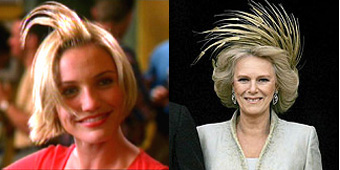
Paul Anderson writes: I can't be the only person who has been thinking this.

7 April 2005
CRETINO-LEFTISM - 1: THE NEW STATESMAN
This week's New Statesman comes up with possibly the most idiotic scheme for voting in the general election yet devised: vote against Labour in any vulnerable seat where the sitting Labour MP is not a supporter of Gordon Brown.
Among the sitting MPs it wants beaten "to give Blair a bloody nose" are some of Labour's best, including quite a few who used to contribute to the Statesman in my time on the magazine.
Sorry, but a Parliamentary Labour Party without Charles Clarke, John Reid, Harriet Harman, Kim Howells, Calum MacDonald, Phil Woolas and Wayne David – to take just a handful of the Statesman's chosen victims – would be a lot worse than the one we've got now. Clarke in particular would be a serious loss: he's the only current member of the cabinet who might (in certain circumstances) stand a chance against Brown in a post-Blair leadership contest.
This can't be dismissed as a freak opinion piece: the list was put together by the magazine's editor, Peter Wilby, and one of the contributors he thanks is John Kampfner, his political editor. As a onetime deputy editor of the Statesman, I'm ashamed of them.
Among the sitting MPs it wants beaten "to give Blair a bloody nose" are some of Labour's best, including quite a few who used to contribute to the Statesman in my time on the magazine.
Sorry, but a Parliamentary Labour Party without Charles Clarke, John Reid, Harriet Harman, Kim Howells, Calum MacDonald, Phil Woolas and Wayne David – to take just a handful of the Statesman's chosen victims – would be a lot worse than the one we've got now. Clarke in particular would be a serious loss: he's the only current member of the cabinet who might (in certain circumstances) stand a chance against Brown in a post-Blair leadership contest.
This can't be dismissed as a freak opinion piece: the list was put together by the magazine's editor, Peter Wilby, and one of the contributors he thanks is John Kampfner, his political editor. As a onetime deputy editor of the Statesman, I'm ashamed of them.
TORIES SELECT THATCHERITE TWIT IN ARUNDEL
And the successor to Howard Flight is . . . Nick Herbert, flat tax enthusiast (click here).
6 April 2005
LABOUR SHOULD NOT READMIT THIS CHUMP
There has been a lot today on Paul Marsden, the retiring Lib Dem MP for Shrewsbury, elected as Labour in 1997, who has now re-ratted to Labour again. But no one has asked whether Labour will have him back. And there is a strong case for refusing him membership – not, I hasten to add, because Labour should not welcome back onetime renegades but because the man is a complete ass.
SOMETHING IS HAPPENING HERE AND I DON'T KNOW WHAT IT IS
The hype about this being the bloggers' first election passed me by, I'm afraid, but something very wierd is going on: my site-meter tells me that twice as many people as normal are reading this weblog. Oo-er: at this rate Gauche will have a bigger readership than the Morning Star by May Day.
5 April 2005
NO TO THE ACADEMIC BOYCOTT — 1
The Association of University Teachers, of which I am a member, is contemplating an academic boycott of Israel (see story here). I am strongly opposed to it, not because I approve of Israeli occupation of the West Bank and Gaza – I don't – but because:
Israeli universities are not reponsible for the actions of the Israeli government or the Israeli army any more than British universities are responsible for the actions of the British government or the British army.
I believe it important not only to maintain but to strengthen academic links between British universities and both Israeli and Palestinian universities because I think such links can play a small but significant part in encouraging dialogue between Israelis and Palestinians.
A boycott – whatever the intentions of its supporters – would have no effect except to give succour to anti-Semites.
HEY! HO! LET'S GO!
A few useful tools for following the election: first, the BBC’s Poll Tracker, which allows you to compare all the latest opinion polls (here); second, from the excellent Keele University Political Science Resources website, comprehensive constituency-by-constituency results from the 2001 election (here); third, the Financial Times election site (here), which if 2001 is anything to go by, should be the best of the newspapers’ efforts; and, fourth, tacticalvoter.net (here), just in case you’re still in any doubt about how best to beat the Tories.
NO-HOPER LEAVES LABOUR SHOCK
The defection to the Liberal Democrats of Stephen Wilkinson, hitherto Labour candidate for Ribble Valley, has been milked for all it is worth by Charles Kennedy and his chums, and you can't blame them for that.
But is it really that significant? Though the Lib Dems won it once in a by-election, Ribble Valley is now one of the safest Tory seats in the country, and Labour hasn't the faintest chance of winning. Here's how it voted in 2001:
Nigel Evans (Conservative) 25,308 (51.5%)
Mike Carr (Lib Dem) 14,070 (28.6%)
Marcus Johnstone (Labour) 9,793 (19.9%)
So Wilkinson's defection is that of a complete no-hoper. Did it really deserve the prominence it got on the Today programme?
But is it really that significant? Though the Lib Dems won it once in a by-election, Ribble Valley is now one of the safest Tory seats in the country, and Labour hasn't the faintest chance of winning. Here's how it voted in 2001:
Nigel Evans (Conservative) 25,308 (51.5%)
Mike Carr (Lib Dem) 14,070 (28.6%)
Marcus Johnstone (Labour) 9,793 (19.9%)
So Wilkinson's defection is that of a complete no-hoper. Did it really deserve the prominence it got on the Today programme?
THE BROADCASTERS' NIGHTMARE - 2
So it's not going to happen – the royal wedding and the Pope's funeral on the same day, that is. But wait! The wedding now clashes with the Grand National. . .
4 April 2005
THE BROADCASTERS' NIGHTMARE – 1
It appears that the Pope's funeral and the royal wedding could well coincide. "Thanks for that, Nicholas, and we'll be back to you for more from Windsor soon. Now over to Jeremy Bowen in Rome. What's the mood like there, Jeremy?"
2 April 2005
CUBA SOLIDARITY – 5
Oliver Kamm has a good post here.
Support for the overthrow of Castro’s tyranny ought to be as much an issue for progressive opinion as was opposition to the Pinochet dictatorship in Chile. It is clearly not regarded that way.
1 April 2005
TROTSKYISM TODAY
I'm not making a habit of recommending The Nation, but this piece by Raymond Aronson on Isaac Deutscher's recently republished biography of Trotsky is excellent:
It has always been tempting, in the 1930s, in the 1960s and again today, to look for the original sin of the Bolshevik revolution. But what if it was the revolution itself? Not its radicalism and not its use of violence but rather the vanguard party's determination to assume power over a backward society in the first place, and in the single-party state that followed? . . .
It turns out that hope based on illusion is no more than a false hope, and has led, time and again, to disaster. But that is the easy lesson. The more difficult one is that sometimes it takes a lifetime, even generations, to dispel the power of illusion.
Subscribe to:
Posts (Atom)