

21 February 2006

19 February 2006
HOW TO LOSE THE NEXT ELECTION - 2
Here's the FT on the smoking ban:
Burning resentment at smoking ban in Labour's heartlands
Lighting up might not be the only habit broken in working men's clubs, where feelings are running high, writes Chris Tighe
If Labour wished to alienate supporters in its traditional heartlands, it is difficult to imagine a more effective way than presiding over a ban on smoking in working men's clubs.
Tony Blair might be well advised to stay away from Trimdon Labour Club. The one-time bedrock of grassroots support in his Sedgefield constituency, its members were outraged by Tuesday night's vote to ban smoking. They had hoped that membership clubs would be excluded from the ban.
"Disgraceful"; "nanny state"; an "encroachment of civil liberties"; "Margaret Thatcher in trousers" are some of the printable responses from north-east clubmen to the decision to ban smoking in their premises.
Tom Satterthwaitfe, secretary of the Northumberland Club and Institute Union, says: "Labour's not the working man's party now; it's not what it was when Wilson and them were in charge." His Newcastle office has been inundated with calls from angry clubmen. Labour, he says, might get a shock at the next election. "They've lost the plot."
It is not only the prospect that some clubs, if deserted by smokers, might close that has irritated him. Recent licensing and regulatory changes, all adding enormously to club overheads, have left him smarting about Labour's priorities.
Breaking a lifetime's habit, Mr Satterthwaite will not vote Labour at the next general election. He says he might switch to the Conservatives, depending on how David Cameron, the leader, shapes up. For a former miner, the son of a miner, this is a huge shift.
Down at Lemington Labour Club, on Newcastle's western edge, many share his disillusion. Traditional allegiances were already wobbling. Of a group of four one-time Labour men, one voted National Front at the last general election and one Conservative.
The two who stayed loyal are perturbed now. "Margaret Thatcher was replaced by a rightwing Labour government which has been trying to tell the working man what to do ever since," says ex-smoker Michael Lyon.
Some north-east clubs have contacted the CIU nationally suggesting that MPs be barred from clubs in protest.
David Clelland, MP for Tyne Bridge and Labour chairman of the all-party parliamentary group for non-profit making private members' clubs, accepts there will be a backlash against the total ban, which he did not support, but does not expect a disproportionate effect".
However Paul Trippett, manager of Trimdon Labour Club and one of the men who helped the young Blair secure nomination as Labour's Sedgefield candidate, is among those worried by the ban. He feels it illustrates Labour's "middle clas-sism". As a general election edges nearer, it will be a "running sore".
Banning fox hunting; promoting ID cards; outlawing public smoking; all trouble Mr Trippett, a Labour Durham county councillor. People worry "what next?", he says. The Conservatives can gain advantage here, he warns, by talking about freedom of the individual.
Mr Trippett fears the nanny state is taking hold. "I think people should be helped to stand on their own - and then left."
He suspects some middle-class Labour MPs do not understand the working class - especially those not motivated by health issues.
"Those who don't want to get into shape very much don't want to," he says. "I drive everywhere, I drink too much, I eat too much. That's what I want to do."
15 February 2006
HOW TO LOSE THE NEXT ELECTION - 1
The decision to ban smoking in pubs and clubs is wrong. If I want to have a cigarette with my beer, it's nobody's business but my own — and I really resent being told I can't by a bunch of non-smokers who visit the pub at most once a month for a nice meal.
But the ban is also, from the point of view of the Labour Party, stupid. Most of the people who are going to be angry about the ban are people who smoke in pubs and clubs. And a very large number of them are working-class and hitherto Labour voters. Even though opposition MPs also voted for the ban, it will inevitably be associated with the insufferable Patricia Hewitt and the government. It might not be Labour's poll tax, but I think it will cost the party dozens of seats.
But the ban is also, from the point of view of the Labour Party, stupid. Most of the people who are going to be angry about the ban are people who smoke in pubs and clubs. And a very large number of them are working-class and hitherto Labour voters. Even though opposition MPs also voted for the ban, it will inevitably be associated with the insufferable Patricia Hewitt and the government. It might not be Labour's poll tax, but I think it will cost the party dozens of seats.
12 February 2006
RESPECT BELIEVERS, NOT THEIR BELIEFS
Paul Anderson, Tribune column, 10 January 2006*
The hoo-hah over the publication of cartoon images of Muhammad has been so disproportionate that I’m almost apologetic about bringing it up in this column. Almost, but not quite — because someone has to make the point that the real story is the disproportionality of the hoo-hah.
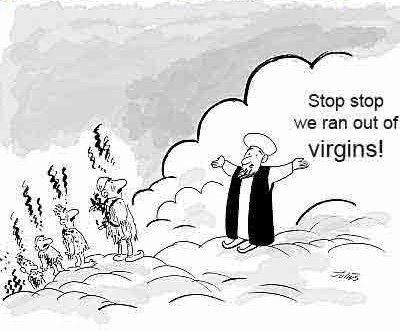
The most remarkable thing about the cartoons published months ago in the Danish newspaper Jyllands-Posten is that only one of them is funny — the one of the Prophet greeting the suicide bombers in Paradise with the words “Stop, stop, we ran out of virgins”. (If you haven’t seen them, they’re on the internet here among other places.) The rest of them are at best dull and at worst asinine — the one of Muhammad with a bomb in his turban. But that might be because the origin of the cartoons was a complaint by a children’s author that illustrators would only work anonymously on a book explaining Islam to Danish kids for fear of violence from Islamist extremists. Maybe the cartoons weren’t supposed to be side-splittingly hilarious.
OK, the cartoons broke a Muslim prohibition on depicting the Prophet in illustrations. But so what? That prohibition has been broken inumerable times before without anyone making any fuss, not least by Muslims who don’t think it matters very much. More important, to state the obvious, it is not a prohibition most of the Jyllands-Posten cartoonists or the editors of Jyllands-Posten accept. And why should they, any more than they accept Muslim bans on eating pork or drinking alcohol or engaging in extra-marital sex?
All right, I admit that there is a difference, in that a devout Muslim in Copenhagen would not find it hard to avoid inadvertently munching bacon sandwiches, swigging beer or having sex but might easily inadvertently see the cartoons in Jyllands-Posten. Publishing, by definition, is not a simply matter of private behaviour.
It’s clear too, that Jyllands-Posten was deliberately attempting to provoke a reaction when it decided to publish, and by some accounts it seems to have been motivated by a rather crude antipathy to Islam.
I also accept that the cartoons might offend Muslims either because they include images of the Prophet or because a few of them (though by no means all) ridicule aspects of their faith — the ban on depicting the Prophet, the vision of Paradise, the doctrine of jihad (holy war).
But again, in the end, so what? Even if Jyllands-Posten’s provocation was gratuitous and unsophisticated — and I’m not convinced it was — it is entirely legitimate to ridicule religious belief. And much of Islam richly deserves ridicule. The same goes for Christianity, Judaism and every other religion. There is a long and distinguished tradition of ridiculing religion that goes back to the Enlightenment. And no one has the right not to be offended.
Which is not to say that Jyllands-Posten was right to publish the cartoons — just that it had a right to do so, and that that right is worth defending against the far-from-spontaneous expressions of Muslim outrage that swept the world last week. I would have expected Labour politicians in Britain to make this point emphatically and unambiguosly. Instead, we’ve had the grim spectacle of Jack Straw mumbling platitudes about how evil it is to give offence to believers and how important it is for editors to be “responsible”.
The British press has also played a far from glorious role in the affair. No newspaper has republished the cartoons — which is probably sensible given the hysteria whipped up against them by radical Islamists. Publication would place foreign correspondents and other Brits in severe danger in large swathes of the world.
But where were the clear expressions of the inalienable right to publish material offensive to religious believers? OK, there were a few in columns by the usual secularist suspects. The overwhelming majority of pundits and leader-writers opted for rambling on evasively about not pouring petrol on raging fires and the need to understand the depth of religious faith in the Islamic world. Only the Sun admitted — and then obliquely — that a major reason the papers didn’t publish is that they were scared that a Muslim boycott could harm sales.
This is not to suggest that secular democrats should abandon religious tolerance. Respect for the believer’s freedom to choose what he or she believes is another of the great legacies of the Enlightenment that deserves unconditional defence (against, among others, the most radical Islamists). But respect for the believer is not the same thing as respect for the believer’s belief. And if we can’t make it clear that this is a fundamental principle of our society, we’ve got a big problem.
* Copy not used as a result of a cock-up on the right date but run a week later. No hard feelings.

The hoo-hah over the publication of cartoon images of Muhammad has been so disproportionate that I’m almost apologetic about bringing it up in this column. Almost, but not quite — because someone has to make the point that the real story is the disproportionality of the hoo-hah.
The most remarkable thing about the cartoons published months ago in the Danish newspaper Jyllands-Posten is that only one of them is funny — the one of the Prophet greeting the suicide bombers in Paradise with the words “Stop, stop, we ran out of virgins”. (If you haven’t seen them, they’re on the internet here among other places.) The rest of them are at best dull and at worst asinine — the one of Muhammad with a bomb in his turban. But that might be because the origin of the cartoons was a complaint by a children’s author that illustrators would only work anonymously on a book explaining Islam to Danish kids for fear of violence from Islamist extremists. Maybe the cartoons weren’t supposed to be side-splittingly hilarious.
OK, the cartoons broke a Muslim prohibition on depicting the Prophet in illustrations. But so what? That prohibition has been broken inumerable times before without anyone making any fuss, not least by Muslims who don’t think it matters very much. More important, to state the obvious, it is not a prohibition most of the Jyllands-Posten cartoonists or the editors of Jyllands-Posten accept. And why should they, any more than they accept Muslim bans on eating pork or drinking alcohol or engaging in extra-marital sex?
All right, I admit that there is a difference, in that a devout Muslim in Copenhagen would not find it hard to avoid inadvertently munching bacon sandwiches, swigging beer or having sex but might easily inadvertently see the cartoons in Jyllands-Posten. Publishing, by definition, is not a simply matter of private behaviour.
It’s clear too, that Jyllands-Posten was deliberately attempting to provoke a reaction when it decided to publish, and by some accounts it seems to have been motivated by a rather crude antipathy to Islam.
I also accept that the cartoons might offend Muslims either because they include images of the Prophet or because a few of them (though by no means all) ridicule aspects of their faith — the ban on depicting the Prophet, the vision of Paradise, the doctrine of jihad (holy war).
But again, in the end, so what? Even if Jyllands-Posten’s provocation was gratuitous and unsophisticated — and I’m not convinced it was — it is entirely legitimate to ridicule religious belief. And much of Islam richly deserves ridicule. The same goes for Christianity, Judaism and every other religion. There is a long and distinguished tradition of ridiculing religion that goes back to the Enlightenment. And no one has the right not to be offended.
Which is not to say that Jyllands-Posten was right to publish the cartoons — just that it had a right to do so, and that that right is worth defending against the far-from-spontaneous expressions of Muslim outrage that swept the world last week. I would have expected Labour politicians in Britain to make this point emphatically and unambiguosly. Instead, we’ve had the grim spectacle of Jack Straw mumbling platitudes about how evil it is to give offence to believers and how important it is for editors to be “responsible”.
The British press has also played a far from glorious role in the affair. No newspaper has republished the cartoons — which is probably sensible given the hysteria whipped up against them by radical Islamists. Publication would place foreign correspondents and other Brits in severe danger in large swathes of the world.
But where were the clear expressions of the inalienable right to publish material offensive to religious believers? OK, there were a few in columns by the usual secularist suspects. The overwhelming majority of pundits and leader-writers opted for rambling on evasively about not pouring petrol on raging fires and the need to understand the depth of religious faith in the Islamic world. Only the Sun admitted — and then obliquely — that a major reason the papers didn’t publish is that they were scared that a Muslim boycott could harm sales.
This is not to suggest that secular democrats should abandon religious tolerance. Respect for the believer’s freedom to choose what he or she believes is another of the great legacies of the Enlightenment that deserves unconditional defence (against, among others, the most radical Islamists). But respect for the believer is not the same thing as respect for the believer’s belief. And if we can’t make it clear that this is a fundamental principle of our society, we’ve got a big problem.
* Copy not used as a result of a cock-up on the right date but run a week later. No hard feelings.
5 February 2006

2 February 2006
BUY DANISH - 1
Some fascinating stuff from the Danish Bacon and Meat Council:

According to DBMC research, bacon is an impulse purchase for many consumers. Twenty-three per cent of consumers who buy bacon in multiples are not planning to buy it when they enter the store - a much higher proportion than for many other staple foods.
Many consumers - 38 per cent remember in store that they need to stock up while others buy on impulse when they see the fixture. This reflects the commodity nature of bacon - it's often a staple for the fridge that often isn't included on the shopping list.
This reinforces the need to maintain a well-stocked, appealing display and emphasises the need for strong promotional activity. Impulse purchasing patterns underline the need for well-stocked and well-maintained fixtures at all times, as well as the availability of premium products to which an impulse shopper can upgrade.
On average, shoppers spend 20 seconds at the bacon rasher counter, which is longer than at many fixtures in-store. The reason for this extended stay is the nine-step thought process that bacon-buying entails.
Research reveals that the consumer makes the first three decisions in the selection process before he or she enters the store: to look for bacon rashers, the cure (smoked or unsmoked) and the cut (back, middle or streaky). These are subconscious decisions based on habit and preferences.
The second stage is a conscious process. A consumer will, on average, consider two or three products, comparing in order, leanness, packaging, price promotions and the number of rashers. Then they decide which product to buy.

I LIKE THIS ONE
Of all the cartoons of the Prophet published by the Danish newspaper Jyllands-Posten, I think this is the best.

"As for the Muslim Paradise, with its 77 houris per man, all presumably clamouring for attention at the same moment, it is just a nightmare." George Orwell, Tribune, 24 December 1943.
On this, I'm backing Harry's campaign.

"As for the Muslim Paradise, with its 77 houris per man, all presumably clamouring for attention at the same moment, it is just a nightmare." George Orwell, Tribune, 24 December 1943.
On this, I'm backing Harry's campaign.

27 January 2006
SO FAREWELL, THEN, CHARLES KENNEDY - 4
I was a student at the London College of Printing at Elephant and Castle in 1982-83, which meant that the Bermondsey by-election was very much on my patch. I have a vivid memory of the Labour rally in the LCP refectory at which Michael Foot (a little belatedly) turned out to back Peter Tatchell, the Labour candidate he had previously disowned. (He had apparently got him confused with Peter Taaffe, the editor of Militant.) I was an anarchist at the time and heckled Foot -- I shouted "Whitewash!" when he explained his previous disavowal of Tatchell -- and was told by a burly proletarian steward to shut up, get out or have my face smashed in. I shut up ... hey, but did I get feted like Walter Wolfgang?
Whatever, I'm intrigued by Simon Hughes -- who beat Tatchell in that by-election as a Liberal and has been MP for the constituency ever since -- coming out as gay. Bermondsey was an utterly vicious by-election campaign, and the viciousness was all down to Tatchell's opponents -- in what had been a safe Labour seat -- making a big thing of his sexuality.
I don't remember the leaflet "Simon Hughes: The Straight Choice" that has been much mentioned in the past 48 hours as evidence of Hughes's hypocrisy, but that's small beer. It was playing the anti-gay card but with a measure of restraint.
I do however remember the "Which Queen Are You Voting For?" stickers and posters that were all over the lamp-posts and billboards in the last week of the campaign -- pics of Peter T and HM the Q next to the slogan. I might well have one somewhere, though it would take some time to dig it out.
I'd always thought that it was the old corrupt Labour right, supporters of Bob Mellish, the retiring MP, that was behind those. Their candidate in the by-election was the Tammany Hall Labourite John O'Grady, former leader of Southwark council, and their campaign was defined by its disgusting and crude homophobia. O'Grady toured the constituency on a horse-drawn brewer's dray, if I remember rightly, singing a song about how Tatchell liked it up the bum.
But today in the Independent, Tatchell is quoted as saying that he was told by a Liberal activist that the "Which Queen Are You Voting For?" material was put out by Hughes's campaign.
If Tatchell is right, Hughes is a complete scumbag.
Whatever, I'm intrigued by Simon Hughes -- who beat Tatchell in that by-election as a Liberal and has been MP for the constituency ever since -- coming out as gay. Bermondsey was an utterly vicious by-election campaign, and the viciousness was all down to Tatchell's opponents -- in what had been a safe Labour seat -- making a big thing of his sexuality.
I don't remember the leaflet "Simon Hughes: The Straight Choice" that has been much mentioned in the past 48 hours as evidence of Hughes's hypocrisy, but that's small beer. It was playing the anti-gay card but with a measure of restraint.
I do however remember the "Which Queen Are You Voting For?" stickers and posters that were all over the lamp-posts and billboards in the last week of the campaign -- pics of Peter T and HM the Q next to the slogan. I might well have one somewhere, though it would take some time to dig it out.
I'd always thought that it was the old corrupt Labour right, supporters of Bob Mellish, the retiring MP, that was behind those. Their candidate in the by-election was the Tammany Hall Labourite John O'Grady, former leader of Southwark council, and their campaign was defined by its disgusting and crude homophobia. O'Grady toured the constituency on a horse-drawn brewer's dray, if I remember rightly, singing a song about how Tatchell liked it up the bum.
But today in the Independent, Tatchell is quoted as saying that he was told by a Liberal activist that the "Which Queen Are You Voting For?" material was put out by Hughes's campaign.
If Tatchell is right, Hughes is a complete scumbag.
24 January 2006
GET YOUR CHEQUES OUT FOR THE CAUSE
My alma mater, the venerable left weekly Tribune, has a problem: it has been sued for libel by a Tory, and it needs serious money -- because he has settled out-of-court for a five-figure payment.
The cash is tight, but as Bob Dylan put it, I think it can be very easily done. A hundred donations of £100 makes £10,000 -- so please, comrades, cough up.
Send £50 or £100 -- or more if you can afford it -- to Tribune Special Appeal Fund, c/o Finance department, Tribune, 9 Arkwright Road, London NW3 6AN. Make cheques payable to Tribune Publications Ltd.
Here's the story, from an ad in the current issue:
The cash is tight, but as Bob Dylan put it, I think it can be very easily done. A hundred donations of £100 makes £10,000 -- so please, comrades, cough up.
Send £50 or £100 -- or more if you can afford it -- to Tribune Special Appeal Fund, c/o Finance department, Tribune, 9 Arkwright Road, London NW3 6AN. Make cheques payable to Tribune Publications Ltd.
Here's the story, from an ad in the current issue:
AN URGENT FINANCIAL APPEAL FOR LEGAL COSTS
Tribune's recent success in putting the magazine's future onto more secure ground and improving circulation has suffered a serious setback in the form of threatened legal action for libel.
In spite of our best endeavours to check the accuracy of a story, we got it wrong. And in spite of publishing a full apology we have been obliged to meet substantial legal costs and damages. In our edition of 29 July 2005 we wrongly stated that the Conservative Leader of Westminster Council, Simon Milton, had offended the gay community in that borough by opposing the flying of the rainbow flag. In fact Cllr Milton is on record as supporting the liberalisation of planning law to enable the rainbow flag to be displayed in establishments in Westminster.
Tribune accepted that the article was defamatory and at the earliest opportunity we published an unreserved apology to Cllr Milton in the same prominent position within the paper as the original article. However, the demand for damages was pursued and the outcome, including costs, was a substantial bill to Tribune. Although Cllr Milton has allowed us time to pay, this is a highly damaging blow at a time when, with scant resources, we were planning a period of continued growth and development.
Many thanks to the following for their generous assistance: lan Aitken, Tony Bodley, AJ Hurt, Barry and Ann Camfield, James Dickens, David Fearnhead, Michael Foot, Simon Fowler, Margit and Geoffrey Goodman, AJ and T Hesp, Peter Jones, Kenneth May, Nicholas Mole, Lawrie Nerva, Keith Rennolds, Tricia Sumner.
If you feel you can help Tribune overcome this current problem and help ensure our survival please send donations urgently to:
TRIBUNE SPECIAL APPEAL FUND, c/o FINANCE DEPT. 9 ARKWRIGHT ROAD, LONDON NW3 6AN.
22 January 2006
IT'S JUST LIKE WATCHING IPSWICH
Here’s how Charlton Athletic lined up against Chelsea away in the Premiership today:
T Myhre, L Young, J Fortune, H Hreidarsson, C Powell, D Rommedahl (40 M Bent), M Holland, R Kishishev, B Hughes, D Ambrose (90 S Bartlett), D BentAnd here’s how Ipswich Town lined up against Bradford City away in the Championship on 1 February 2003:
A Marshall, C Makin, T Gaardsoe, M Holland, F Wilnis (45 D Bent), H Hreidarsson, T Miller, J Wright, J Magilton (78 M Reuser), P Counago (53 D Ambrose), M BentStrange, huh?
I DON'T DO THIS NORMALLY BUT...
Just because Lady M thinks I shan't, I shall. Here is my take on the 7/7 meme:
7 things to do before I die:
1. Finish my book on the British left and the Soviet Union.
2. Go freelance again.
3. Visit Georgia (the country not the American state).
4. Finish decorating my study and get a carpet for it and sort out the lighting so it’s easy to read.
5. Get some new specs.
6. Quit smoking.
7. Learn to drive.
7 things I cannot do:
1. Play any musical instrument.
2. Drive.
3. Quit smoking.
4. Write coherently while drunk.
5. Marriage.
6. Read comfortably in my study with the lighting as it is.
7. Religion.
7 things that attract me to London:
1. Work.
2. Friends.
3. It’s not too far from home and I can get breakfast on the train if I want.
4. The Prince Arthur, Charles Square N1.
5. The British Library.
6. Hampstead Heath, Blackheath, Hyde Park.
7. Fleet Street, Clerkenwell, the East End.
7 things I often say:
1. Er…
2. An Adnams please.
3. Twenty Marlboro Light.
4. OK, everybody – could you all just shut up? Like now? OK, this week I’m going to be looking at…
5. Ah, hello Roy, thanks for getting back, how are you? I’ve just got a small query on your copy.
6. Can I have a period return with a Network Card?
7. That’s complete bollocks.
7 books that I love:
1. Homage to Catalonia (George Orwell)
2. The Making of the English Working Class (Edward Thompson)
3. New Grub Street (George Gissing)
4. The Talented Mr Ripley (Patricia Highsmith)
5. Paterson (William Carlos Williams)
6. Memoirs of a Revolutionist (Dwight Macdonald)
7. Twentieth Century British Political Facts (David and Gareth Butler)
7 movies I watch over and over again:
1. The Front Page (Wilder)
2. Some Like It Hot (Wilder)
3. Monsieur Hulot’s Holiday (Tati)
4. Mon Oncle (Tati)
5. The Third Man (Reed)
6. Way Out West (Laurel and Hardy)
7. Kings Of The Road (Wenders)
7 people I want to join in too:
I'm not going that far.
SO FAREWELL, THEN, CHARLES KENNEDY - 3
A truly shocking fact in the story of Mark Oaten, who withdrew from the Lib Dem leadership race just before the News of the World revealed his liaison with a rent boy. As the Observer puts it:
Well done, that rent boy.
The man recognised him from the TV last February.
Well done, that rent boy.
17 January 2006
SO FAREWELL, THEN, CHARLES KENNEDY - 2
Now, I don't really want to get into this, but it has to be said. Every single one of the contenders for the Lib Dem leadership is, as Neil Kinnock would have put it, completely, totally and utterly hopeless.
Ming, oh dear. Simon, oh gawd. The dynamic Mark Oaten — you just can't have a haircut like that in modern politics. Chris Huhne — er, who he?
It's excruciating.
Ming, oh dear. Simon, oh gawd. The dynamic Mark Oaten — you just can't have a haircut like that in modern politics. Chris Huhne — er, who he?
It's excruciating.
13 January 2006
FRATERNAL GREETINGS TO THE RENEGADE AARONOVITCH
David Aaronovitch now has a blog. It's got to be better than Catherine Bennett's spoof Norman Johnson column in the Guardian. Hasn't it?
12 January 2006
WHAT SHOULD GO ON RADIO 4 - 2
A big post-bag on this, and most respondents seem to agree with my hit-list. But I'm tempted by this alternative from Padraig Reidy of New Humanist, which grasps what's worst on R4 much better than I did:
1. Something Understood
2. Sunday
3. Quote Unquote
4. Midweek
5. Thought for the Day
No. Please, turn it off!
1. Something Understood
2. Sunday
3. Quote Unquote
4. Midweek
5. Thought for the Day
No. Please, turn it off!
11 January 2006
KAMM'S NEO-CONSERVATISM - 2
Oliver Kamm (click here) has returned fire on my post on his book, saying that I’ve misread his remarks on the Labour left in the 1940s and that I’m wrong about the political character of the 1980s peace movement. So it's time to get personal.
On the first point, he writes:
As for the 1980s peace movement, Kamm writes of my claim that the dominant political tendency was the European Nuclear Disarmament group, which stood for “a nuclear-free Europe from Poland to Portugal” and engaged in a long and fruitful dialogue with dissidents in the Soviet bloc:
OK, it’s old stuff. But it still matters to me.
On the first point, he writes:
So far from grouping the post-war Tribune left with the pro-Soviet elements, I stress that the pro-Soviet elements were a minuscule minority, with almost the entire labour movement ranged against them.To which I can only riposte that, even on a third reading of his chapter, I still don’t think he makes it clear enough that the communist fellow-travellers – the likes of Konni Zilliacus, D. N. Pritt and John Platts-Mills – were a tiny minority on the Labour left. And I still don't think that he accepts that "an independent socialist commonwealth of Europe" was an entirely worthy goal (maybe even one we can aim for again in the 21st century?) – even if it was put in abeyance by Stalin's seizure of Hungary, Poland, Czechoslovkia et al. But never mind.
The Crossman-Foot-Mikardo line was undermined almost as soon it was published, by Stalin’s opposition to Marshall Aid, Czechoslovakia and Berlin – and to their credit its authors understood this. So far from thinking Tribune left-wingers were useful idiots – a spurious phrase often attributed to Lenin and that I’ve never used – I praise them for realising that an independent socialist commonwealth of Europe was unattainable…
In the 1940s the democratic left was almost monolithic in its acknowledgement of the threat of Soviet totalitarianism.
As for the 1980s peace movement, Kamm writes of my claim that the dominant political tendency was the European Nuclear Disarmament group, which stood for “a nuclear-free Europe from Poland to Portugal” and engaged in a long and fruitful dialogue with dissidents in the Soviet bloc:
This is mostly wrong. I certainly accept that END and Edward Thompson had no sympathies for the Soviet Union. But they were not, as Paul claims, the mainstream of the peace movement, let alone the dominant faction. Having been there, Paul will recall the debates within CND on whether to campaign against Nato membership, when John Cox of the Communist Party of Great Britain defeated the line argued by Thompson and Jonathan Dimbleby at CND’s annual conference in 1981. Moreover, Thompson’s argument that disarmament and human rights were inextricable causes clearly didn’t survive the collapse of Communism. Finally, the END call for a nuclear-free Europe from Poland to Portugal had more alliterative appeal than political realism; the troops in Poland weren’t there by invitation. It is quite correct that Vic Allen and the Stalinists were far from the mainstream of the 1980s peace movement. But I do consider that those in CND, such as Paul, who reviled Allen’s support for the GDR had a responsibility to rupture the Popular Front, and they didn’t. How could they, when the dominant voice of the British peace movement was, in fact, affable, silly Bruce Kent glorying in the coalition of Communists and Quakers?Here, I’m afraid, I’m standing my ground. I accept that END and its allies were defeated in several political battles in CND during the 1980s, but overall we won more than we lost. For most of the 1980s, ENDers and END sympathisers ran the CND campaigning apparatus. We never managed to get CND to embrace our support for dissidents in the Soviet bloc, but we did ensure that it demonstrated for “No cruise, no Pershing, no SS-20s” -- opposing nukes west and east -- and that it participated in the European Nuclear Disarmament Convention process, engaged seriously with the Labour Party and never turned its nominal commitment to withdrawal from Nato into a campaigning priority.
OK, it’s old stuff. But it still matters to me.
10 January 2006
WHAT SHOULD GO ON RADIO 4
Andy Kershaw has started something. My top five for the chop now Home Truths has met a deserved end:
1. You and Yours
2. Money Box
3. Midweek with Libby Purves
3. Thought for the Day
4. Woman's Hour
What do you think?
1. You and Yours
2. Money Box
3. Midweek with Libby Purves
3. Thought for the Day
4. Woman's Hour
What do you think?
8 January 2006
SO, FAREWELL THEN, CHARLES KENNEDY - 1
The removal of Charles Kennedy as Liberal Democrat leader has been a particularly unpleasant business, and I have a hunch that it’s going to be very difficult for the Lib Dems to get over it. I can see why so many of his fellow Lib Dem MPs thought he had to go: he was a shambolic leader, too fond of the pop, apparently clueless about what to do next.
But now he’s gone, they’ve got a bigger problem – because, for all Kennedy’s faults, they don’t currently have anyone better. Menzies Campbell is an insufferable patrician toff; Simon Hughes is a happy-clappy vicar. And that’s about it when it comes to recognisable faces. There’s that bloke with the glasses, and the other one who’s bald – no, not the bald one with the glasses, the other one. Oh, and there’s that woman who won … where was it? No, not her, the blonde.
Add to the mix the arrival of David Cameron as Tory leader, and the Lib Dems look set for a dire time post-Kennedy – and that’s if they manage to keep under control their increasingly fierce internal ideological divisions. Of course, they might just find their own Cameron, a hitherto obscure but dynamic young figure around whom they can unite, and go on to sustain or even improve on their electoral performance in 2005. But hunch says it will be Campbell and a vicious circle of falling opinion poll ratings, panic and internal squabbling.
Some on the left would no doubt welcome a Lib Dem implosion, but I’m not one of them. The main beneficiaries of a collapse in the Lib Dem vote would be the Tories. Not only are they the main challengers to sitting Lib Dem MPs in the overwhelming majority of Lib Dem seats, they would also gobble up the anti-Labour vote elsewhere.
Until now, I’ve been sceptical about claims that the Tories could win in 2009, even after Cameron’s victory. But now I’m not so confident. Indeed, if Cameron manages to complete his centrist repositioning of the Tories, the Lib Dems collapse and Labour botches the succession from Tony Blair, they could even be a shoo-in.
But now he’s gone, they’ve got a bigger problem – because, for all Kennedy’s faults, they don’t currently have anyone better. Menzies Campbell is an insufferable patrician toff; Simon Hughes is a happy-clappy vicar. And that’s about it when it comes to recognisable faces. There’s that bloke with the glasses, and the other one who’s bald – no, not the bald one with the glasses, the other one. Oh, and there’s that woman who won … where was it? No, not her, the blonde.
Add to the mix the arrival of David Cameron as Tory leader, and the Lib Dems look set for a dire time post-Kennedy – and that’s if they manage to keep under control their increasingly fierce internal ideological divisions. Of course, they might just find their own Cameron, a hitherto obscure but dynamic young figure around whom they can unite, and go on to sustain or even improve on their electoral performance in 2005. But hunch says it will be Campbell and a vicious circle of falling opinion poll ratings, panic and internal squabbling.
Some on the left would no doubt welcome a Lib Dem implosion, but I’m not one of them. The main beneficiaries of a collapse in the Lib Dem vote would be the Tories. Not only are they the main challengers to sitting Lib Dem MPs in the overwhelming majority of Lib Dem seats, they would also gobble up the anti-Labour vote elsewhere.
Until now, I’ve been sceptical about claims that the Tories could win in 2009, even after Cameron’s victory. But now I’m not so confident. Indeed, if Cameron manages to complete his centrist repositioning of the Tories, the Lib Dems collapse and Labour botches the succession from Tony Blair, they could even be a shoo-in.
25 December 2005
OLIVER KAMM’S NEO-CONSERVATISM
I’ve been an avid reader of Oliver Kamm’s weblog (click here) since he started it – and his new book, Anti-Totalitarianism: The Left-wing Case for a Neoconservative Foreign Policy, is as readable and as feisty as you’d expect it to be.
I also agree with its basic thesis, that at some point in the past half-century much of the left in Britain and America -- and elsewhere, though most of his examples are decidedly Anglo-Saxon – forgot a crucial lesson of the 1930s and 1940s, that opposition to totalitarianism should be at the very core of foreign policy in every democratic polity.
But when it comes to the detail, I’m afraid I part company. He’s got too much of his history horribly wrong.
Kamm starts well, identifying the failure of the most of the 1930s left (with hindsight quite extraordinary) to recognise either (a) that the rise of Hitler necessitated rearmament or (b) that the Soviet Union was a totalitarian power and at best an unreliable ally against Nazism.
After that, however, he loses the plot, starting with his account of the British left in the 1940s. He’s right that some of the left was sympathetic with Stalin then. But he lazily elides the outlook of the tiny group of Labour Soviet fellow-travellers with that of the “third force” left, the dominant Labour left faction – grouped around Tribune – which from 1945 until 1947-48 argued for a united democratic socialist Europe independent of both Washington and Moscow (a position most famously articulated in the pamphlet Keep Left). Both the fellow-travellers and the Keep Leftists, were, in Kamm’s view, equally gullible useful idiots for Moscow.
Yet that simply wasn’t the case. The “third force” left was never of one mind, but it included some of the most consistent left critics of Soviet society and Soviet foreign policy (among them George Orwell, Arthur Koestler and Franz Borkenau). And nearly all the “third force” left was driven by events – in particular the seizure of power in east-central Europe by communists backed by Soviet occupiers – to accept that an anti-totalitarian western European alliance with the United States, as advocated by Ernest Bevin, the Labour foreign secretary, was the only option for democratic socialists. By 1948, the Labour left was emphatically pro-Nato. But you don’t get a hint of it from Kamm.
More important, despite Kamm’s claims to the contrary, this remained the dominant perspective of the democratic left in the Labour Party for the next 50 years – regardless of its criticisms of US policy, regardless of its opposition to nuclear arms and regardless of regular outbreaks of wishful thinking about how the Soviet Union and its satellites might be on the brink of democratic reform.
There was always a tiny group of hardline pro-Soviet left-wingers in the Labour Party, including several MPs: Frank Allaun, Ron Brown and James Lamond spring to mind from the 1980s. They were fools and worse, and they should not have been tolerated as they were – but they were never the majority of the left, even during the left’s enthusiasms for the false dawns of Khruschev’s thaw or Gorbachev’s glasnost.
The overwhelming majority of Labour’s unilateral disarmers and critics of US foreign policy – from Nye Bevan to Robin Cook – remained committed to British membership of Nato; and some of them were the most outspoken critics of “actually existing socialism” in British politics.
In the Labour Party, it was the Realpolitiker crew on the right – with Denis Healey in the vanguard from the 1940s until the 1980s – that, after its initial cold-war enthusiasm for confronting communism, most consistently argued for accommodation with Khruschev, Brezhnev, Andropov et al and opposed any western action whenever Moscow clamped down.
Apologists for the Soviet Union did play a bigger role in the Campaign for Nuclear Disarmament, at least in its 1980s manifestation, than in the Labour Party. But again they were not in the driving seat, contrary to Kamm’s suggestions. Throughout the 1980s, CND was dominated politically by supporters (mainly soft-left – Footite, Kinnnockite – Labour) of the European Nuclear Disarmament campaign, the group led by Edward Thompson that argued for disarmament by both superpowers in Europe and promoted dialogue with – and supported – dissidents in the Soviet bloc. I deputy-edited END’s magazine, and I can vouch for the fact that Vic Allen, the hardline Stalinist on the CND executive who, it recently emerged, spied for the Stasi, was as much our enemy as he was MI5’s.
END, along with various libertarian and Trotskisant leftists – Solidarity, Labour Focus on Eastern Europe – kept up a relentless critique of Soviet totalitarianism (though we rarely used the word) long after the Labour right had drifted into Kissingeresque Realpolitik. The demonstrations against the imposition of martial law in Poland in 1981 were organised by expat Poles and the libertarian left outside the Labour Party, not by cold-war right-wing social democrats. And if you were looking for anti-totalitarianism in the mid-1980s, it wasn’t happening in the public pronouncements of John Gilbert or the rest of the Nato-loyal right-wing Labour establishment: the sound of freedom was END talking to Vaclav Havel.
There’s more than one way to be anti-totalitarian, in other words, and it’s not essential for anti-totalitarians always to adopt the most hawkish foreign policy stance available. The utility of confrontation or military intervention or negotiation and diplomacy has to be judged case by case. Kamm is right to emphasise the principle of anti-totalitarianism – but there’s no need for anti-totalitarianism to make you a neo-con.
I also agree with its basic thesis, that at some point in the past half-century much of the left in Britain and America -- and elsewhere, though most of his examples are decidedly Anglo-Saxon – forgot a crucial lesson of the 1930s and 1940s, that opposition to totalitarianism should be at the very core of foreign policy in every democratic polity.
But when it comes to the detail, I’m afraid I part company. He’s got too much of his history horribly wrong.
Kamm starts well, identifying the failure of the most of the 1930s left (with hindsight quite extraordinary) to recognise either (a) that the rise of Hitler necessitated rearmament or (b) that the Soviet Union was a totalitarian power and at best an unreliable ally against Nazism.
After that, however, he loses the plot, starting with his account of the British left in the 1940s. He’s right that some of the left was sympathetic with Stalin then. But he lazily elides the outlook of the tiny group of Labour Soviet fellow-travellers with that of the “third force” left, the dominant Labour left faction – grouped around Tribune – which from 1945 until 1947-48 argued for a united democratic socialist Europe independent of both Washington and Moscow (a position most famously articulated in the pamphlet Keep Left). Both the fellow-travellers and the Keep Leftists, were, in Kamm’s view, equally gullible useful idiots for Moscow.
Yet that simply wasn’t the case. The “third force” left was never of one mind, but it included some of the most consistent left critics of Soviet society and Soviet foreign policy (among them George Orwell, Arthur Koestler and Franz Borkenau). And nearly all the “third force” left was driven by events – in particular the seizure of power in east-central Europe by communists backed by Soviet occupiers – to accept that an anti-totalitarian western European alliance with the United States, as advocated by Ernest Bevin, the Labour foreign secretary, was the only option for democratic socialists. By 1948, the Labour left was emphatically pro-Nato. But you don’t get a hint of it from Kamm.
More important, despite Kamm’s claims to the contrary, this remained the dominant perspective of the democratic left in the Labour Party for the next 50 years – regardless of its criticisms of US policy, regardless of its opposition to nuclear arms and regardless of regular outbreaks of wishful thinking about how the Soviet Union and its satellites might be on the brink of democratic reform.
There was always a tiny group of hardline pro-Soviet left-wingers in the Labour Party, including several MPs: Frank Allaun, Ron Brown and James Lamond spring to mind from the 1980s. They were fools and worse, and they should not have been tolerated as they were – but they were never the majority of the left, even during the left’s enthusiasms for the false dawns of Khruschev’s thaw or Gorbachev’s glasnost.
The overwhelming majority of Labour’s unilateral disarmers and critics of US foreign policy – from Nye Bevan to Robin Cook – remained committed to British membership of Nato; and some of them were the most outspoken critics of “actually existing socialism” in British politics.
In the Labour Party, it was the Realpolitiker crew on the right – with Denis Healey in the vanguard from the 1940s until the 1980s – that, after its initial cold-war enthusiasm for confronting communism, most consistently argued for accommodation with Khruschev, Brezhnev, Andropov et al and opposed any western action whenever Moscow clamped down.
Apologists for the Soviet Union did play a bigger role in the Campaign for Nuclear Disarmament, at least in its 1980s manifestation, than in the Labour Party. But again they were not in the driving seat, contrary to Kamm’s suggestions. Throughout the 1980s, CND was dominated politically by supporters (mainly soft-left – Footite, Kinnnockite – Labour) of the European Nuclear Disarmament campaign, the group led by Edward Thompson that argued for disarmament by both superpowers in Europe and promoted dialogue with – and supported – dissidents in the Soviet bloc. I deputy-edited END’s magazine, and I can vouch for the fact that Vic Allen, the hardline Stalinist on the CND executive who, it recently emerged, spied for the Stasi, was as much our enemy as he was MI5’s.
END, along with various libertarian and Trotskisant leftists – Solidarity, Labour Focus on Eastern Europe – kept up a relentless critique of Soviet totalitarianism (though we rarely used the word) long after the Labour right had drifted into Kissingeresque Realpolitik. The demonstrations against the imposition of martial law in Poland in 1981 were organised by expat Poles and the libertarian left outside the Labour Party, not by cold-war right-wing social democrats. And if you were looking for anti-totalitarianism in the mid-1980s, it wasn’t happening in the public pronouncements of John Gilbert or the rest of the Nato-loyal right-wing Labour establishment: the sound of freedom was END talking to Vaclav Havel.
There’s more than one way to be anti-totalitarian, in other words, and it’s not essential for anti-totalitarians always to adopt the most hawkish foreign policy stance available. The utility of confrontation or military intervention or negotiation and diplomacy has to be judged case by case. Kamm is right to emphasise the principle of anti-totalitarianism – but there’s no need for anti-totalitarianism to make you a neo-con.
Subscribe to:
Comments (Atom)